
Last Updated: November 22, 2026
Quick Summary
These five anti bullying activities for elementary students each fit into 20 to 30 minutes and need only paper, markers, and floor space: Upstander Role-Play, Compliment Card Exchange, Kindness Pledge Signing, Empathy Circle, and Classroom Kindness Chain. Each targets a different skill, from recognizing bullying to practicing upstander behavior and committing publicly to kindness. Kindergarten students can run all five with adaptations like puppets, drawing, and handprints.
- Define bullying aloud as repeated, intentional, and power-imbalanced, and note that conflict between equals is different.
- Offer an observer role in role-play and never require a child to play the aggressor.
- Cap the kindergarten closing discussion at two minutes and let the picture sort or handprint carry the learning.
- Keep the printable packet to six to eight pages per activity with a one-page facilitator script.
- Revisit the signed kindness pledge weekly for one minute so accountability stays visible.
Table of Contents
- Why Anti Bullying Activities Belong in Every Elementary Classroom
- 5 Anti Bullying Activities for Elementary Students in the Classroom
- Anti Bullying Activities for Kindergarten: Adapting the Same Lessons for Younger Students
- Anti Bullying Project Ideas That Extend Learning School-Wide
- Bullying Activities for Kids PDF: Printable Resources and Facilitator Scripts
- Bringing the Message to Life with a High-Energy School Assembly
- Frequently Asked Questions
Why Anti Bullying Activities Belong in Every Elementary Classroom
Bullying prevention works best when it lives inside the daily rhythm of a classroom, not in a single assembly or a one-time lecture.
The research base agrees. The CDC’s bullying prevention resources treat bullying as a relationship problem, which means students need practice in real interactions, not just information.
Three reasons these activities are worth keeping on the calendar:
- They build shared language. Students learn what unkindness looks like before it escalates.
- They protect quiet students. Structured activities give every child a script for speaking up.
Below are five anti bullying activities for elementary students, each with an academic objective, step-by-step instructions, and facilitator prompts a principal can hand to any teacher.
5 Anti Bullying Activities for Elementary Students in the Classroom
These five activities fit into 20 to 30 minutes each and need only paper, markers, and floor space. Each targets a different skill: recognizing bullying, practicing upstander behavior, giving genuine compliments, committing publicly to kindness, and seeing the cumulative effect of small positive acts.
Activity 1: The Upstander Role-Play Station
Academic Objective: Students distinguish bullying from ordinary conflict and rehearse safe bystander responses.
Steps:
- Define bullying aloud: repeated, intentional, and power-imbalanced. Conflict between equals is different.
- Set up three stations: ignore-and-report, distract-and-support, and invite-and-include.
- Give pairs a scenario card. They practice one response for two minutes.
- Rotate stations. Close with a two-minute debrief.
Facilitator prompt: “If you saw this happening to a friend, what is one safe thing you could do in the first ten seconds?”
Watch out: Role-play can re-traumatize students who have experienced bullying. Offer an observer role and never require a child to play the aggressor.
Activity 2: Compliment Card Exchange
Academic Objective: Students practice specific, genuine praise and experience the effect of positive peer attention.
Steps:
- Each student writes their name on a paper bag.
- Students write one specific compliment card for three classmates.
- Deliver cards, then give two quiet minutes to read them.
- Ask: “What made a compliment feel real?”
Facilitator prompt: “Name the behavior, not the appearance. ‘You helped me at recess’ beats ‘you’re nice.'”
Activity 3: The Kindness Pledge Signing
Academic Objective: Students make a public, specific commitment to kindness and understand accountability.
Steps:
- Draft the pledge as a class in plain language students choose.
- Each student signs and adds one personal action they will take.
- Post the signed pledge where the class can see it.
- Revisit it weekly for one minute.
Facilitator prompt: “A pledge is a promise with a plan. What is your one action this week?”
Activity 4: Empathy Circle Discussion
Academic Objective: Students build feeling vocabulary and practice perspective-taking.
Steps:
- Seat students in a circle. Pass a talking piece.
- Ask one open question: “Tell about a time someone made you feel included.”
- Each student shares or passes. No comments between shares.
- Close by naming the feelings the class heard.
Facilitator prompt: “What might the person on the outside of the game be feeling right now?”
Activity 5: Classroom Kindness Chain
Academic Objective: Students connect individual acts to collective classroom climate.
Steps:
- Cut paper strips in advance.
- Each time a student reports or performs a kind act, add a link.
- Write the act on the strip in a few words.
- Count links at week’s end and display the chain.
Facilitator prompt: “Whose kind act made your day easier this week?”
| Activity | Time | Best For | Skill Built |
|---|---|---|---|
| Upstander Role-Play | 25 min | Grades 2-5 | Safe response rehearsal |
| Compliment Cards | 20 min | All grades | Specific positive feedback |
| Kindness Pledge | 15 min | All grades | Public commitment |
| Empathy Circle | 20 min | Grades 1-5 | Feeling vocabulary |
| Kindness Chain | Ongoing | All grades | Collective climate |
Time needed for each anti bullying activity
Anti Bullying Activities for Kindergarten: Adapting the Same Lessons for Younger Students
Kindergarten students can run all five activities, but the developmental ceiling is real. Five- and six-year-olds think in concrete, present-tense terms, so abstract words like “repeated” and “power imbalance” mean nothing until attached to a picture, a puppet, or a feeling face. Keep the objective, shrink the time, swap writing for drawing or dictation, and give one instruction per step.
Activity 1, Upstander Role-Play, kindergarten version. Replace live role-play with two hand puppets. The teacher voices a puppet who is being left out, and the class tells the puppet one safe thing to do: tell a grown-up, invite the puppet to play, or sit with the puppet. Two minutes maximum.
Activity 2, Compliment Cards, kindergarten version. Pre-print cards with three picture prompts: a helping hand, a sharing symbol, and a smiling face. Students draw or dictate one compliment to a classmate, and the teacher writes the words. Debrief concretely: “Which card would you want to get, and why?”
Activity 5, Kindness Chain, kindergarten version. One link per day, added by the teacher, with the child naming the act.
Facilitator language for this age band. Short, concrete, and present-tense.
Measuring learning at this level. Skip written pre/post tests.
Watch out: Kindergarten adaptations often fail because the teacher keeps the older grade’s debrief length.
For broader assembly ideas that pair with these classroom lessons, see school assembly ideas for elementary students.
Anti Bullying Project Ideas That Extend Learning School-Wide
Classroom activities gain traction when the whole building reinforces them. These anti bullying project ideas turn individual lessons into a school-wide campaign students can see, hear, and join.
- Kindness week: One activity per day, announced each morning.
- Wear-blue solidarity day: Students and staff wear one color to signal a shared stand.
- Poster campaign: Classes design anti-bullying posters with positive messages for hallways.
Character development assemblies reinforce the same vocabulary the classroom uses. Browse school assembly ideas for character development to match an assembly theme to your campaign.
Bullying Activities for Kids PDF: Printable Resources and Facilitator Scripts
A printable packet is what makes these activities survive a substitute teacher, a mid-year hire, or a principal who needs every classroom running the same lesson by Friday.
- One scenario card set per activity, printed on cardstock and cut in advance
- A one-page facilitator script per activity with opening, steps, and closing prompts
- A compliment card template with a picture-supported version
What a facilitator script should actually say. The script is the teacher’s opening and closing language, written out so it can be delivered the same way in every room.
Discussion prompts that do the work. The debrief is where the learning lands, and generic prompts (“How did that feel?”) produce generic answers. Prompts that name a behavior or a choice produce usable responses:
- “What is one safe thing you could do in the first ten seconds?”
- “Who is a grown-up you could tell, and what would you say?”
- “What is the difference between someone being unkind once and someone being unkind again and again?”
The reflection sheet is the measurement piece most schools skip. Three questions before a unit and the same three after tell a principal whether the lessons moved the needle: “Name one thing bullying looks like.” “Name one grown-up you can tell.” “Name one thing you can do if you see bullying.” Score each response as can-name, partial, or cannot-name, and tally by classroom. A class that moves from mostly cannot-name to mostly can-name has a defensible result; a class that does not move tells you the lesson needs reteaching, not that the program failed.
A simple observation check for teachers. Ask each teacher to note two things during the unit: whether students used the class’s shared vocabulary unprompted, and whether any student reported a concern to an adult. Neither is a formal measure, but together they show whether the language is transferring from lesson to hallway.
Watch out: Packets grow until no one uses them. Cap the whole thing at six to eight pages per activity and keep the facilitator script to one page.
Bringing the Message to Life with a High-Energy School Assembly
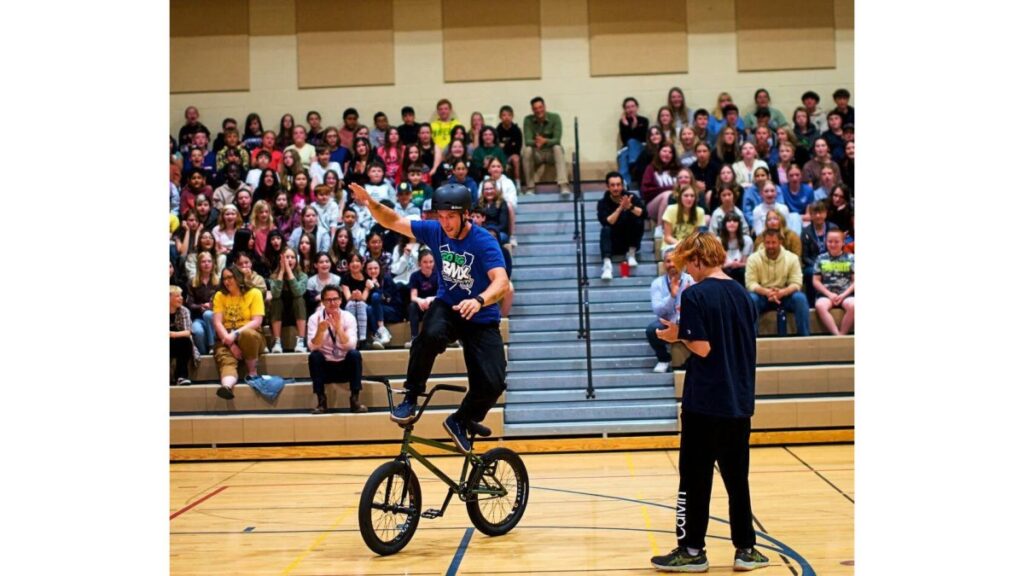
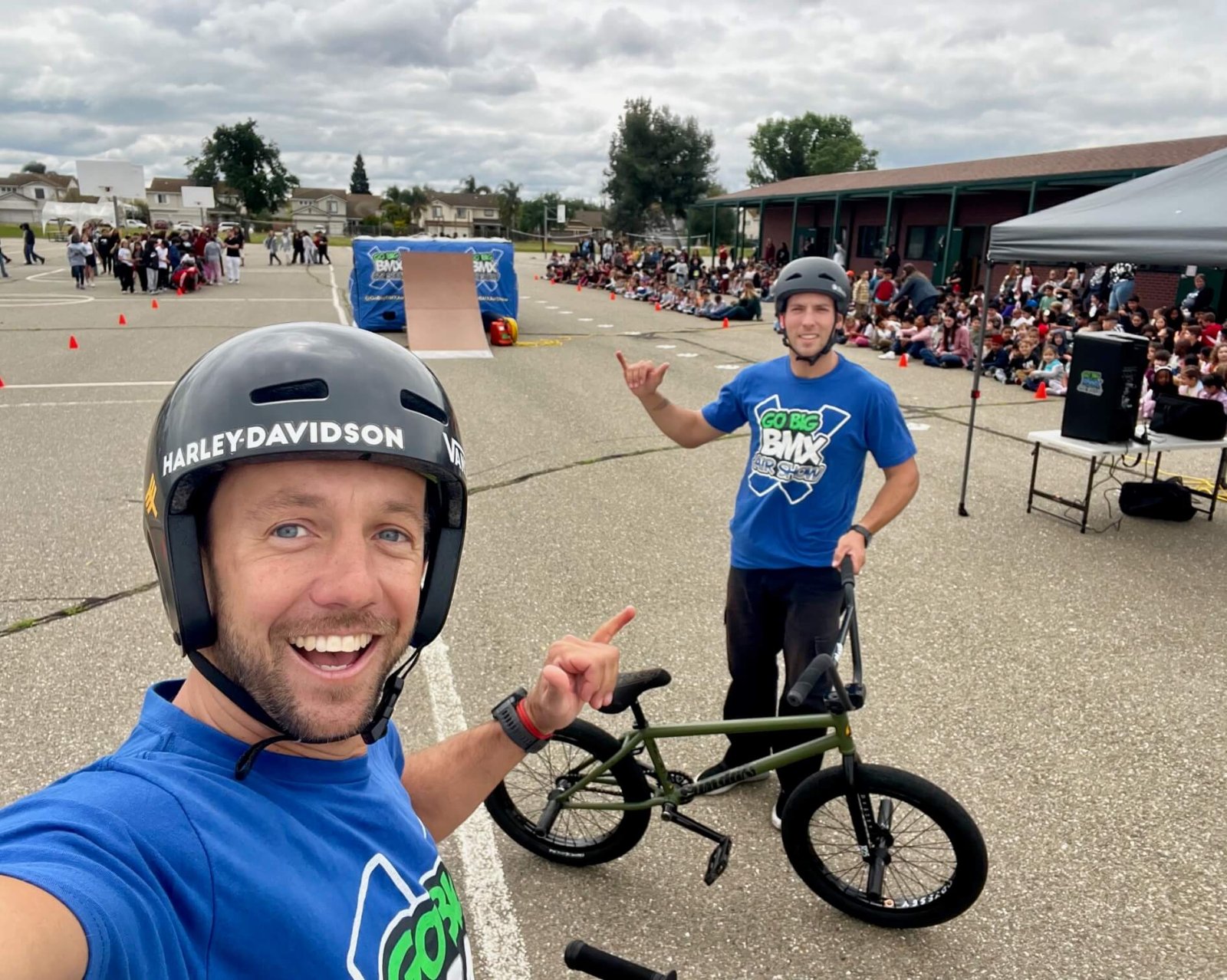
Classroom activities build the skills. The BMX School Assembly from GO BIG BMX AIR Show combines professional BMX stunt performances with anti-bullying messaging delivered by positive role-model athletes, and the format answers the objection principals raise most often: that assemblies feel preachy and fake.
The stunts earn attention. The message lands because students see athletes they respect talking about respect, resilience, and standing up for others.
To see how the program reinforces classroom lessons, read how anti-bullying school assemblies work and what makes an anti-bullying assembly program effective. When a date is set, check availability and booking details.
Principals who want kindness lessons to outlast the week need both pieces: repeatable classroom routines and one unforgettable shared event.
Frequently Asked Questions
What are some activities I can do on an anti-bullying day?
Plan a mix of quick, high-impact anti bullying activities that fit different energy levels. Start with a school-wide pledge signing so every student commits publicly to kindness. Follow with compliment card exchanges in homeroom, an upstander role-play station during lunch, and a kindness chain that grows across the day as students add links for acts of respect. Close with a short assembly or classroom discussion where students share what they learned. These activities work best when teachers preview expectations, provide facilitator scripts, and give students a clear reporting pathway if they witness unkind behavior.
How can teachers adapt bullying activities for kids PDF resources to fit their grade level?
Printable bullying activities for kids PDF packs usually include worksheets, scenario cards, and pledge forms. For kindergarten and early elementary, simplify language, use picture-based scenario cards, and keep activities to 10-15 minutes with lots of movement. For grades 3-5, add written reflection prompts, small-group discussion roles, and a short assessment like a exit ticket asking students to name one upstander action they will take. Always preview the PDF for age-appropriate content and pair it with a teacher-led discussion so students connect the worksheet to real classroom behavior.
How do I know if anti bullying activities are actually changing student behavior?
Measure more than smiles. Use simple pre- and post-activity surveys that ask students to define bullying, identify an upstander action, and name one adult they can report to. Track office referrals for unkind behavior and monitor how often students use reporting pathways over a four-to-six week window. Teacher observations of classroom climate, plus student self-reports on empathy and inclusion, give you a fuller picture. Pairing classroom activities with a high-energy school assembly reinforces the message and gives students a shared vocabulary for respect and courage.
What makes a school assembly a good follow-up to classroom anti bullying activities?
A strong assembly reinforces the same vocabulary and expectations students practiced in class, but at scale and with high energy. Look for programs that combine live demonstrations with clear anti-bullying messaging delivered by positive role-model athletes. GO BIG BMX AIR Show has delivered over 10,000 shows in 29-plus years, using pro BMX stunts to hold student attention while athletes talk about respect, upstanding, and personal motivation. The best assemblies give teachers follow-up discussion prompts so the momentum from the event carries back into the classroom.
