
Last Updated: November 2, 2026
Quick Summary
Effective assembly programs for student behavior capture attention with live spectacle, then tie that energy to one clear, repeatable message about respect or self-regulation. The format works because novelty resets attention and emotion strengthens memory, so students remember what they felt. Match the show’s language to your PBIS expectations and measure results with data you already collect.
- Pair a visible demonstration with a short, concrete character message students can repeat.
- Shift messaging by age: simple visuals for elementary, peer participation for middle school, candor for high school.
- Use the same behavior terms students hear in class so the assembly reinforces PBIS.
- Keep the show tight and well paced, since stretching a program to fill time backfires.
- Measure office discipline referrals for four weeks before and after, then recheck at six weeks.
Table of Contents
- Why Effective Assembly Programs for Student Behavior Work
- School Assembly Ideas for Character Development That Stick
- Designing an Anti-Bullying School Assembly That Students Remember
- Connecting Positive Behavior Interventions and Supports to Your Assembly
- How School Assembly Length Impacts Student Engagement
- Measuring Whether Your Assembly Changed Student Behavior
- Frequently Asked Questions
Why Effective Assembly Programs for Student Behavior Work
Effective assembly programs for student behavior succeed because they combine spectacle with a clear message students can repeat. A gym full of students watching a live performance is primed to listen.
The format works because it borrows the psychology of live sport. Students lean forward. They cheer. Their guard drops. In that window, a message about respect or self-regulation lands harder than it would in a quiet classroom.

The Science of Attention and Retention
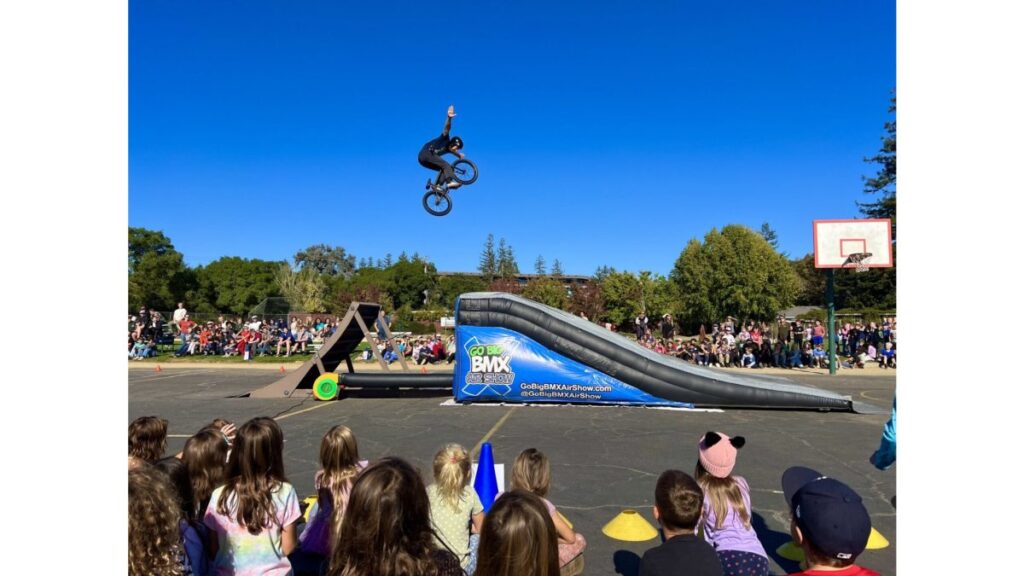
Attention is a limited resource, and novelty resets it. A break from routine makes students notice what is happening. Live stunts add a second layer: physical risk and skill hold focus in a way a slideshow cannot.
Retention follows emotion. Students remember what they felt. When a performer connects a big jump to a lesson about courage or kindness, the lesson rides along with the memory.
- Novelty captures attention
- Emotion strengthens memory
- Repetition across the year makes lessons stick
School Assembly Ideas for Character Development That Stick
Character lessons stick when they are shown, not just stated. Students tune out lectures about respect. They lean into stories about people who lived it. The strongest school assembly ideas for character development pair a visible demonstration with a short, concrete message.
A few formats that work:
- A performer names a character trait, then shows it in action
- A student volunteer joins a safe, guided challenge
- A short story from an athlete’s own life ties the trait to a real choice
Age-Appropriate Activities for Elementary, Middle, and High School
Younger students need simple words, big visuals, and quick energy. Middle schoolers need to feel respected and included. High schoolers need relevance and honesty. The same assembly can flex across all three, but the messaging must shift.
- Elementary: short segments, call-and-response, clear rules
- Middle school: peer participation, real stories, no talking down
- High school: candid tone, real stakes, student voice
Designing an Anti-Bullying School Assembly That Students Remember
An anti-bullying school assembly works when it avoids preaching. Students spot a fake message fast. The fix is to let the action carry the lesson. A performer who fails a trick, gets back up, and names the choice to keep going makes resilience visible.
The connection has to feel earned, not forced. A stunt becomes a metaphor only when the athlete explains the link in plain words.
Connecting Positive Behavior Interventions and Supports to Your Assembly
Positive behavior interventions and supports, often called PBIS, is a school-wide framework for teaching expected behaviors. An assembly can reinforce it if the language matches. Use the same terms students hear in class. Consistency across the curriculum ensures that values like respect and responsibility remain central to the school culture, providing a stable foundation for incorporating seasonal assembly ideas that celebrate historical contributions and community heritage.
- Name the school’s own behavior expectations
- Praise specific actions, not vague goodness
- Tie the show’s message to classroom routines
When the assembly and the PBIS framework speak the same language, students connect the fun to the rules.
How School Assembly Length Impacts Student Engagement
School assembly length matters more than most planners expect. A tight, well-paced show holds attention. A long one loses the room.
Watch out: stretching a program to fill time backfires. Students disengage, and the message fades.
Measuring Whether Your Assembly Changed Student Behavior
Most schools treat an assembly as an event, not an intervention. That is a missed opportunity. A behavior-focused assembly can be evaluated with the same logic a principal already applies to any Tier 1 support: define the outcome, pick a measure, collect a baseline, and compare. When you are ready to act, you can see the actual assembly program you can bring to your school. The steps below are deliberately low-burden so they survive a busy quarter.
Step 1: Name the behavior you expect to move
Pick one or two observable behaviors tied to the assembly message, for example, respectful language during transitions, hallway volume, or bystander reporting of bullying. Vague goals like “better behavior” cannot be measured. Write the goal as a sentence a teacher could verify: “Students will use respectful language in the cafeteria during the two weeks after the assembly.”
Step 2: Choose measures you already have
You do not need new software. Most schools already collect the data below, and each maps to a different question.
- Office discipline referrals (ODRs): Pull referral counts for the four weeks before and the four weeks after the assembly, broken out by behavior type and location. This is the most common pre/post measure in school-wide PBIS practice.
- Attendance: Compare average daily attendance in the two weeks on either side of the event. A small uptick is not proof, but a drop is a warning sign worth investigating.
- Staff surveys: A three-question survey sent one week after the assembly, did students reference the message, did you see the target behavior, would you recommend repeating the program, gives you qualitative signal fast.
- Student surveys: For middle and high school, a short anonymous survey on school climate and bystander confidence can be administered before and after. Keep it to five items or fewer.
- Direct observation: Ask two or three teachers to tally the target behavior during a set 15-minute window (for example, hallway passing) once before and once after. Inter-rater agreement matters, so brief them on the definition first.
Step 3: Set a realistic comparison window
Behavior change from a single assembly is usually modest and short-lived. A common pattern is a visible bump in the first one to two weeks that fades without reinforcement. Plan your post-measure at two weeks and again at six weeks so you can see whether the effect held. If the six-week data shows a return to baseline, that is not a failure of the assembly, it is a signal that follow-up reinforcement is missing.
Watch out: comparing a two-week post-window to a four-week pre-window will inflate or deflate results purely from the time difference. Match your windows.
Step 4: Interpret honestly
A single assembly is one variable in a busy school. If referrals drop, note what else changed, a new schedule, a staffing shift, a seasonal pattern. If referrals rise, check whether reporting improved rather than behavior worsened; a successful anti-bullying message often increases reports in the short term because students feel safer coming forward. Present the data to staff as a conversation starter, not a verdict.
Step 5: Close the loop with staff and families
Share a one-page summary at the next staff meeting: the goal, the measures, what moved, and what the team will reinforce in classrooms over the next month. Send a short version home so families can use the same language. Measurement only changes behavior when the results feed back into routines.
The article lays out a low-burden measurement plan schools can follow to judge whether an assembly shifted student behavior.
| Step | What to do | Key detail |
|---|---|---|
| Step 1 | Name the behavior you expect to move | One or two observable behaviors; write a verifiable goal sentence |
| Step 2 | Choose measures you already have | ODRs, attendance, staff surveys, student surveys, direct observation |
| Step 3 | Set a realistic comparison window | Post-measure at two weeks and again at six weeks |
| Step 4 | Interpret honestly | Note other changes; rising referrals may mean better reporting |
| Step 5 | Close the loop with staff and families | Share a one-page summary at the next staff meeting |
Frequently Asked Questions
What makes a school assembly effective for improving student behavior?
An effective assembly combines high engagement with a clear, actionable message. Students need to be captivated first, then receive lessons they can apply immediately. Programs that use exciting demonstrations, like BMX stunts, hold attention while role-model athletes connect the action to real behavior choices like respect and anti-bullying. The key is making the message memorable and tying it directly to your school’s existing behavior expectations.
How can schools reinforce positive behavior after an assembly?
Reinforcement happens through follow-up. Use morning meetings to discuss the assembly themes, incorporate specific praise when you see students demonstrating the lessons, and reference the assembly during classroom routines. Teachers can create simple reflection activities or journal prompts. The goal is to transfer the assembly’s energy into daily conversations and consistent expectations, turning a one-time event into an ongoing part of your school climate.
How long should a school assembly program be?
School assembly length should match the audience’s attention span. The key is pacing: high-energy segments should be interspersed with clear messaging. An assembly that runs too long loses impact, while one that is too short may not allow enough time for the message to land.
How can schools measure whether an assembly influenced student behavior?
Compare behavior referrals and office discipline data from the weeks before and after the assembly. You can also use simple student surveys asking about key themes, or have teachers note changes in classroom climate. Track specific metrics like bullying reports or hallway disruptions.
Schools want proof that an assembly does more than entertain. GO BIG BMX AIR Show pairs big air stunts with positive role-model athletes and a message about anti-bullying and respect. With 29 years of experience, nationwide availability, and discounted piggyback-rate dates, the show is built to fit a real school calendar. Get your dates and rates list from GO BIG BMX AIR Show and plan a program students will remember.
