
Last Updated: October 25, 2026
Quick Summary
Plan engaging school assemblies for middle schoolers around a 35- to 45-minute format that hooks students in the first five minutes, changes pace every few minutes, and closes with one clear action. Start planning six to eight weeks out, frame each assembly as a question students answer, and build in follow-up so the message lasts beyond the event.
- Middle schoolers need a change of pace every few minutes to stay engaged.
- Interactive activities work best when participation is low-risk and fast.
- Start planning six to eight weeks out and confirm the gym, sound system, and occupancy limit before signing a contract.
- Assign roughly one staff member per 50 to 75 students, with at least two administrators present.
- Run a homeroom follow-up activity within one week or the assembly’s message fades.
Table of Contents
- Why Middle School Audiences Need a Different Assembly Playbook
- Middle School Assembly Ideas That Hold Attention
- Interactive School Assembly Activities That Pull Students In
- How Long Should a School Assembly Length Run?
- Your School Assembly Planning Checklist and Timeline
- Six to Eight Weeks Out: Define Purpose and Audience
- Six Weeks Out: Book the Program and the Room
- Four Weeks Out: Site Visit and Technology Check
- Three Weeks Out: Teacher Communication and Supervision
- Two Weeks Out: Student Framing
- One Week Out: Final Confirmation
- Day Of: Run the Show
- Within One Week After: Follow-Up
- Measuring Engagement and Learning After the Assembly
- Low-Cost, Staff-Led Assembly Options for Tight Budgets
- Activity 1: Student Talent Showcase (30 to 40 minutes)
- Activity 2: Homeroom Team Challenge (35 to 45 minutes)
- Activity 3: Teacher-Led Game Show (30 to 40 minutes)
- Activity 4: Peer Leadership Panel (30 to 35 minutes)
- Activity 5: Virtual or Recorded Assembly (20 to 30 minutes)
- Pairing Staff-Led and Professional Programs
- Request Dates and Rates for Your Middle School Assembly
- Frequently Asked Questions
Why Middle School Audiences Need a Different Assembly Playbook
Planning engaging school assemblies for middle schoolers fails when adults reuse the elementary script. Seventh and eighth graders spot a canned message fast and reward honesty, energy, and a reason to participate.
The core problem is not behavior. It is relevance. A middle schooler asks one silent question during every assembly: “Why should I care?” Answer it in the first five minutes, or the phones come out.
What Changes Between Elementary and Middle School
Elementary students accept adult authority and simple call-and-response. Middle schoolers test both and want to be treated as young adults.
Three shifts matter for program selection:
- Attention span: Elementary students follow a single thread. Middle schoolers need changes of pace every few minutes.
- Social awareness: Peer opinion outweighs teacher opinion. A message lands when students see classmates buying in.
- Skepticism: They detect a scripted, preachy tone almost instantly. Authenticity decides whether the message sticks.
Elementary programs lean on songs and repetition; middle school programs must lean on stakes, story, and student voice. Planners can explore school assembly ideas for elementary school students to see the contrast.
Middle School Assembly Ideas That Hold Attention
The strongest middle school assembly ideas share one trait: students do something, not just watch something.
Five formats consistently work:
- Live performance with a message. Action sports, dance, or music draw the crowd, then a role model ties the spectacle to respect and responsibility.
- Student-led panels. A short peer panel on belonging or bullying carries more weight than an adult lecture.
- Game-show formats. Trivia, relay races, and team challenges turn content into competition.
- Story-driven speakers. A personal story with real stakes beats a list of rules every time.
- Theme weeks with a kickoff assembly. A character development theme launched at an assembly and reinforced in homeroom lasts longer than a one-off event.
Planners who want theme-based options can review school assembly ideas for character development for formats that fit middle school goals.
Frame Each Idea as a Question Students Answer
Turn every assembly idea into a question the audience answers.
Instead of announcing “today we’re talking about respect,” ask: “What does respect look like when no one is watching?” Instead of “don’t bully,” ask: “What would you do if the person being laughed at was your friend?”
Questions shift students from audience to participant, create homeroom discussion material for the next day, and signal that the school trusts students to think, not just listen.
Interactive School Assembly Activities That Pull Students In
Interactive school assembly activities work best when participation is low-risk and fast. Middle schoolers will join in when they cannot embarrass themselves.
Try these:
- Hand votes and quick polls. Ask for a show of hands on a real question. Keep it to ten seconds.
- Relay challenges. Invite a few students up for a short team game with clear rules.
- Call-and-response with a twist. Let students lead the response instead of the presenter.
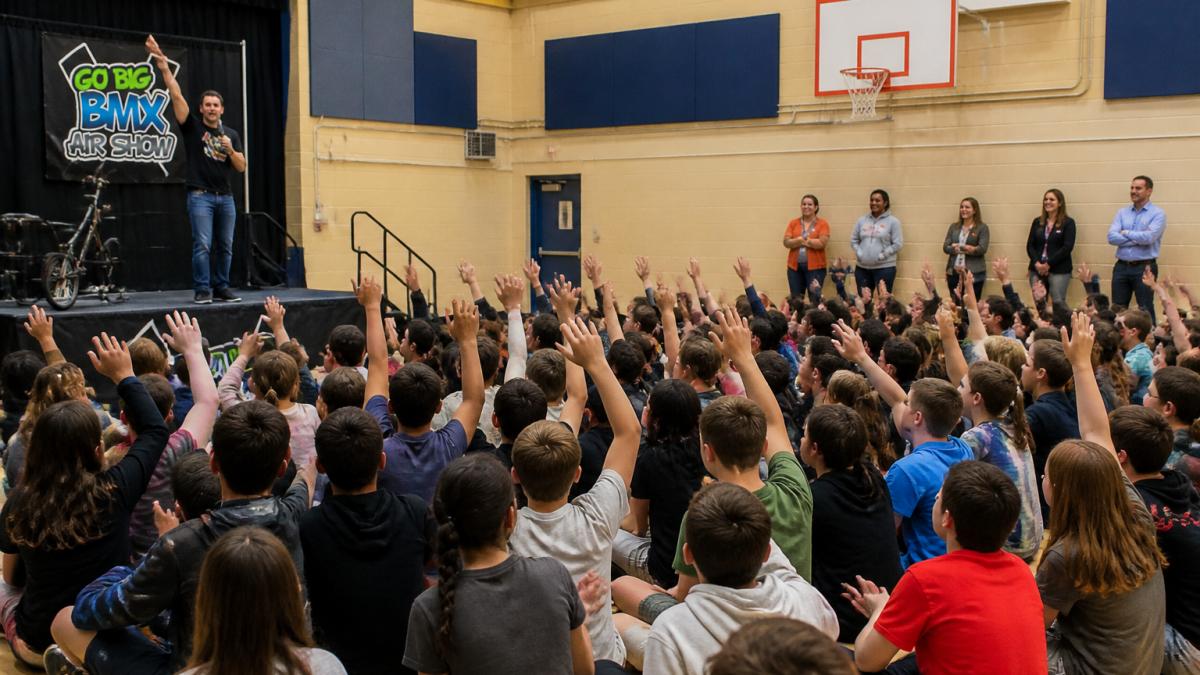
Fostering this level of active participation requires a thoughtful narrative arc that connects the performance to structured interactive lesson plans designed to deepen student engagement.
Anti-bullying assemblies especially need this energy: pairing high-energy demonstrations with a clear message keeps students listening. Readers who want evidence can review anti-bullying school assemblies that work.
How Long Should a School Assembly Length Run?
The right school assembly length for middle schoolers is 35 to 45 minutes. That window holds attention without cutting into class time.
Break it down:
- First 5 minutes: Hook the crowd with energy and a question.
- Next 20 to 25 minutes: Core program, with a change of pace every few minutes.
- Final 5 to 10 minutes: Land the message and give students one clear action.
Anything past 50 minutes invites restlessness. Shorter assemblies work for single-topic kickoffs. Longer ones only fit when the program includes genuine audience involvement throughout.
The recommended middle school assembly length breaks down into three timed segments.
| Segment | Time | What happens |
|---|---|---|
| Opening hook | First 5 minutes | Hook the crowd with energy and a question |
| Core program | Next 20 to 25 minutes | Change of pace every few minutes |
| Closing | Final 5 to 10 minutes | Land the message and give one clear action |
| Total assembly length | 35 to 45 minutes | Holds attention without cutting into class time |
| Upper limit | Past 50 minutes | Invites restlessness |
Your School Assembly Planning Checklist and Timeline
A school assembly planning checklist prevents logistics from eating the message. The planning window matters more for middle schoolers because the schedule is tighter, the gym is shared with athletics, and students need advance framing to buy in. Start six to eight weeks out and work backward; this timeline fits a single 35- to 45-minute assembly serving one or two grade levels.
Six to Eight Weeks Out: Define Purpose and Audience
- Write a one-sentence learning objective, such as “Students will identify two bystander actions they can take when they witness bullying.” An assembly without one cannot be measured later.
- Choose grade levels. Seventh and eighth graders respond differently from sixth graders; mixing all three often dilutes the message, so consider two shorter assemblies rather than one long one.
- Check the master calendar against testing windows, athletic events, and field trips. Spring standardized testing is the most common conflict.
Six Weeks Out: Book the Program and the Room
- Confirm the presenter and sign the contract. Ask for a certificate of insurance naming the school or district as additional insured, most districts require this before a vendor sets foot on campus.
- Reserve the gym or auditorium in the district scheduling system, not just with the athletic director verbally.
- Confirm the bell schedule and identify which class periods the assembly will displace.
Four Weeks Out: Site Visit and Technology Check
- Walk the space with the custodian and AV staff. Confirm microphone type, speaker placement, and whether the gym sound system fills the room without feedback.
- Measure floor area and seating capacity. Middle school gyms typically hold 400 to 800 students; confirm the fire code occupancy limit with the facilities office.
- Mark the presenter’s performance footprint with tape, action sports and large-scale programs need more clearance than a speaker.
Three Weeks Out: Teacher Communication and Supervision
- Send teachers a one-page brief: objective, schedule, seating assignments, and the homeroom follow-up activity.
- Assign supervision, a common ratio is one staff member per 50 to 75 students, with at least two administrators present.
- Plan entry and exit flow. Staggered dismissal by grade level prevents the bottleneck that turns a good assembly into a chaotic one.
Two Weeks Out: Student Framing
- Give homeroom teachers a two-minute preview script; students who know what to expect participate more and act out less.
- Announce interactive elements in advance so volunteers can prepare.
- Share the plan with student council; peer buy-in is the strongest predictor of middle school engagement.
One Week Out: Final Confirmation
- Confirm arrival time, setup window, parking, and load-in path with the presenter.
- Reconfirm the AV check and assign one staff member as the presenter’s point of contact.
- Print exit tickets or prepare a digital survey link for the follow-up.
Day Of: Run the Show
- Assign greeters at the door and a staff member at the stage or performance area.
- Hold a five-minute huddle with staff before doors open to review the dismissal plan.
- Keep a written record of what worked and what did not for next year.
Within One Week After: Follow-Up
- Run the homeroom follow-up activity. An assembly without follow-up fades within days.
- Collect exit tickets or survey responses and share a short summary with staff and administration.
The most common planning mistake is booking the date before checking the gym schedule, the sound system, and the fire code occupancy limit. That single oversight causes more last-minute chaos than any other. Confirm all three before signing a contract.
Build a reusable assembly planning template in a shared drive. Schools that run two or three assemblies a year save hours by keeping the checklist, the teacher brief, and the follow-up prompts in one place.
Measuring Engagement and Learning After the Assembly
Measuring engagement turns a fun day into a documented learning outcome. Principals want evidence, and teachers want material for follow-up.
Simple methods that work:
- Exit tickets. One question on an index card as students leave.
- Homeroom discussion prompts. A five-minute talk the next morning.
- Teacher observation notes. A short form on attention and participation.
Compare results across grades and programs. A program that scores well on attention but poorly on retention needs a stronger follow-up plan, not a louder show.
Low-Cost, Staff-Led Assembly Options for Tight Budgets
Budget-friendly assemblies do not require outside performers. Staff-led formats cost little and still hold a middle school gym when structured, timed, and tied to a learning objective. The activities below fit a 35- to 45-minute assembly with 200 to 600 students, run by teachers and student leaders with supplies most schools already own, and each includes adaptations for students with disabilities, sensory needs, or limited comfort with public participation.
Activity 1: Student Talent Showcase (30 to 40 minutes)
- Materials: Sound system, microphone, printed program, simple lighting if available.
- Format: Six to eight student acts of two to four minutes each, music, dance, spoken word, science demonstrations, or art displays.
- Group size: Whole grade level as audience; acts drawn from across the grade so peer groups see classmates they know.
Activity 2: Homeroom Team Challenge (35 to 45 minutes)
- Materials: Cones, beanbags, or crumpled paper balls; a whistle; a scoreboard.
- Format: Four to six homeroom teams compete in three short relay games with clear rules announced in advance.
- Group size: Teams of eight to twelve; the rest of the grade cheers from assigned sections.
Activity 3: Teacher-Led Game Show (30 to 40 minutes)
- Materials: Projector, slides with questions, buzzers or hand signals, small prizes if budget allows.
- Format: Trivia or review questions tied to the assembly theme, respect, belonging, digital citizenship, with teacher hosts and student contestants.
- Group size: Three to five student contestants per round; the audience answers via hand votes between rounds.
Activity 4: Peer Leadership Panel (30 to 35 minutes)
- Materials: Chairs, microphone, pre-screened questions.
- Format: Four to six student leaders answer questions on school culture, belonging, and bystander behavior, moderated by a staff member.
- Group size: Whole grade level as audience.
Activity 5: Virtual or Recorded Assembly (20 to 30 minutes)
- Materials: Projector or classroom screens, a recorded program, discussion prompts.
- Format: A recorded presentation followed by a live homeroom discussion led by teachers.
- Group size: Classroom-level rather than whole-grade, which reduces crowd-management load.
Pairing Staff-Led and Professional Programs
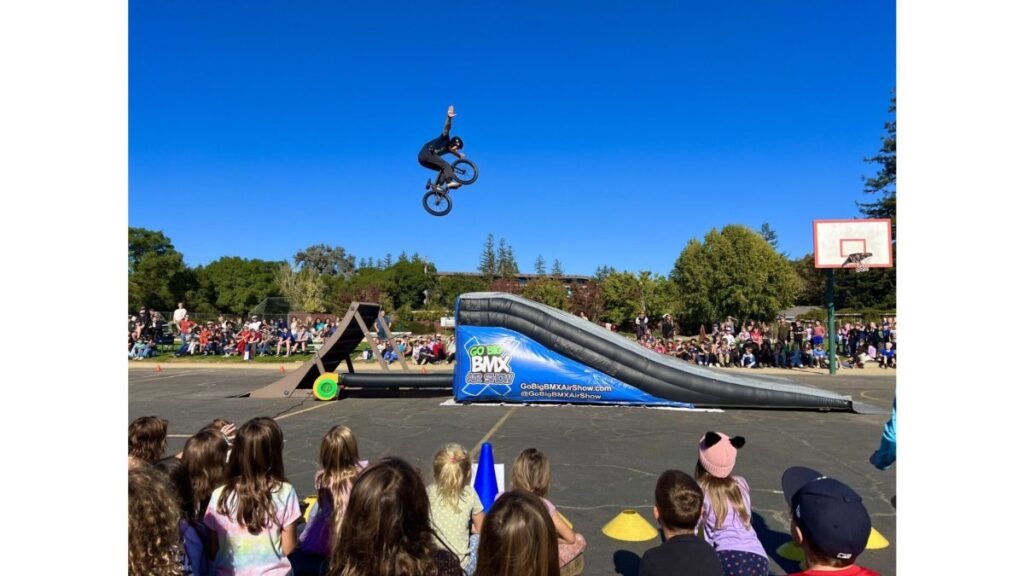
Many schools pair one staff-led event with one professional show per year to balance cost and impact: staff-led assemblies build ownership and cost little, while professional programs bring production value and outside role models. A BMX school assembly is one example of the latter, a high-energy action sports format that pairs big-air demonstrations with a character message students remember. For schools ready to bring in a professional program, the full assembly lineup and formats shows what a large-scale show includes.
Staff-led assemblies succeed when they are structured like a professional show: a clear objective, a timed run of show, defined participant roles, and a follow-up activity. The format matters less than the planning behind it.
Request Dates and Rates for Your Middle School Assembly
Booking early protects the calendar. Popular dates fill months ahead, especially in fall and spring.
Before requesting dates, gather three details: preferred month, grade levels, and gym capacity. That speeds up every quote and avoids back-and-forth. Schools coordinating multiple buildings often qualify for discounted piggyback rates, which lowers the cost per student.
When comparing providers, ask about insurance, safety record, setup requirements, and follow-up materials. A professional program should answer all four without hesitation.
Middle schoolers deserve an assembly that respects their intelligence and their energy. Get started with GO BIG BMX AIR Show and request dates and rates for a middle school assembly students will remember.
Frequently Asked Questions
How do you keep middle school students engaged during an assembly?
Mix movement, questions, and real stakes. Middle schoolers tune out during long speeches, so break the program into short segments and ask for hands, voices, or volunteers every few minutes. Pair the message with something visually exciting, like a live demonstration, and have the presenter speak to students as peers rather than talking down to them. A clear theme, a consistent signal for attention, and staff seated among students all help keep the room focused.
How long should a middle school assembly last?
Most middle school assemblies work best between 30 and 45 minutes. That window is long enough to deliver a real message and short enough to hold attention without cutting into class time. If your program includes a performance plus a character lesson, plan roughly 25 minutes of show and 10 to 15 minutes of message and Q&A. For larger grades, splitting into two shorter sessions often works better than one long one.
What are some interactive school assembly activities for middle schoolers?
Try question-and-answer rounds where students respond with hand signals, a volunteer segment where a few students join the presenter on stage, or a short team challenge between grade levels. You can also run a quick poll before and after the assembly using paper slips or a show of hands. The goal is participation every few minutes, not constant chaos, so build in a reset signal staff can use to bring the room back.
How can schools connect assembly entertainment to learning goals?
Pick one theme, such as respect, anti-bullying, or goal setting, and ask the presenter to tie every segment back to it. Give teachers a short follow-up prompt to use in advisory or homeroom the next day, and have student leadership groups reference the theme in announcements that week. When the assembly, the classroom follow-up, and the school culture messaging all point the same direction, students retain more of the message.
