
Last Updated: November 10, 2026
Quick Summary
Safety standards for school gym stunt shows are the written rules, inspections, and supervision plans that protect students, staff, and performers during a live action sports assembly. They include a signed one-page safety checklist, a pre-event venue inspection with go/no-go criteria, written provider insurance and supervision requirements, and a rehearsed emergency action plan naming people and backups.
- Measure ceiling clearance, floor depth, and clear run-out space before booking any stunt program.
- Treat wet, uneven, or obstructed gym floors as disqualifying for indoor stunt work.
- Set go/no-go criteria in writing before the show date so nobody negotiates in the moment.
- Name people, not roles, plus a backup for each emergency plan scenario.
- Keep a simple incident log at the first aid station, recording even minor scrapes.
Table of Contents
- Why Safety Standards for School Gym Stunt Shows Start Before the First Jump
- BMX Assembly Setup and Space Requirements
- Your School Gym Stunt Show Safety Checklist
- BMX School Assembly Safety Requirements Every Principal Should Ask About
- Building a School Assembly Emergency Action Plan
- Booking a Stunt Show That Puts Student Safety First
- Frequently Asked Questions
Why Safety Standards for School Gym Stunt Shows Start Before the First Jump
Safety standards for school gym stunt shows are the written rules, inspections, and supervision plans that protect students, staff, and performers during a live action sports assembly. They matter most before anyone arrives.
The harder part is the gym floor, the sightlines, the crowd, and the plan for the unexpected.
That is why this guide treats safety as a planning task, not a performance one.
Watch out: a common mistake is booking a show and only then asking where the ramp goes. By then, the date may be locked and the room may not fit the program.
Centers for Disease Control and Prevention guidance on school health and safety
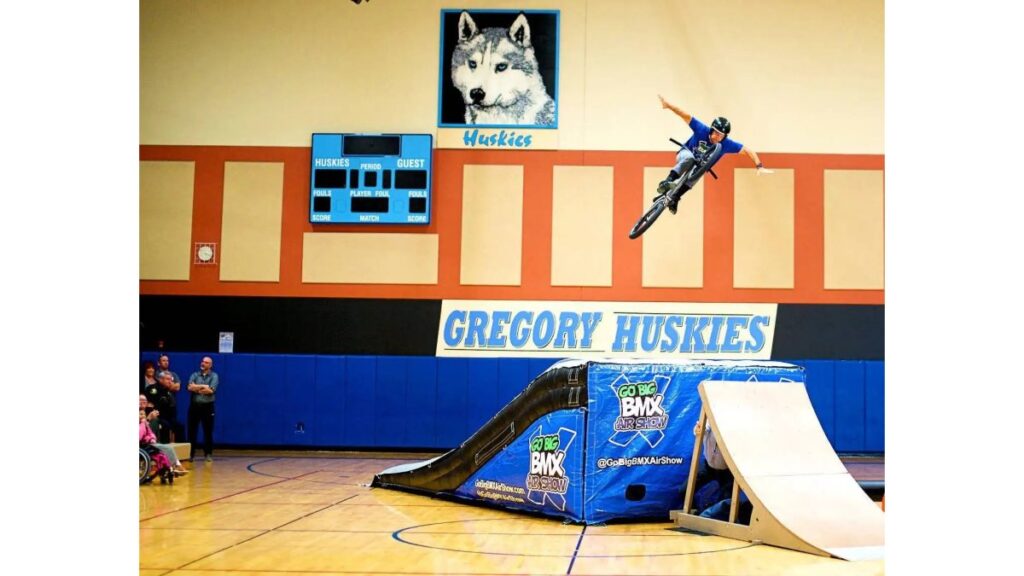
Readers who want to see the actual program behind these standards can review the BMX school assembly format.
BMX Assembly Setup and Space Requirements
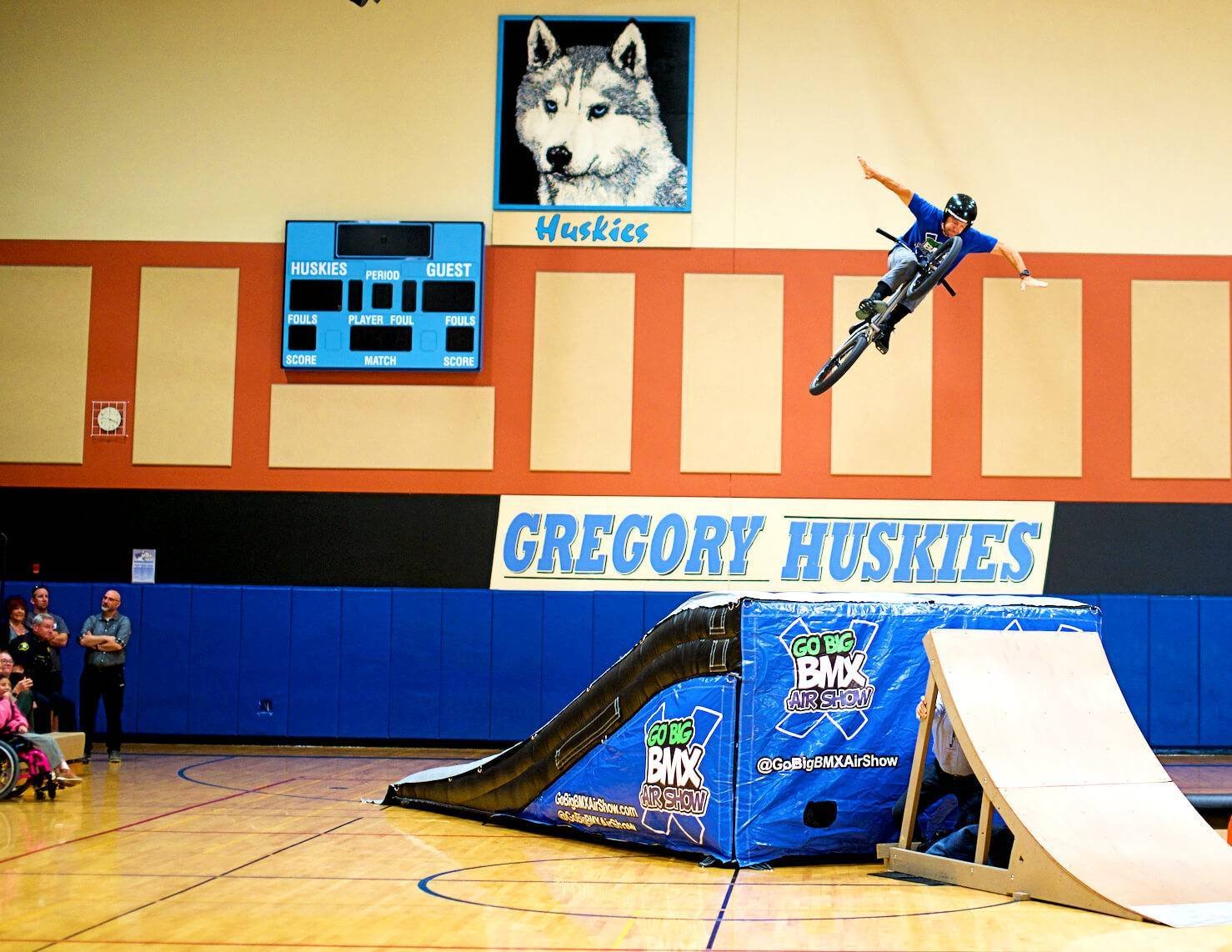
BMX assembly setup and space requirements begin with honest measurements. A gym that hosts basketball and a gym that hosts a ramp show are two different rooms. Event staff need ceiling height, floor depth, and clear run-out space, not just square footage.
Start with these checks:
- Ceiling clearance measured at the highest point of the stunt
- A flat, dry floor with no cracks or raised plates
- Clear run-out zones in front of and behind the ramp
- A backstop or wall that limits where a bike can travel
- Wide, unobstructed access doors for equipment
- A separate, marked route for students entering and exiting
Floor Surface and Obstruction Review
Floor surface review is where most venue problems surface. Concrete, asphalt, and wet or uneven surfaces are disqualifying for indoor stunt work. Gym floors must be dry, clean, and free of obstructions such as chairs, carts, and loose mats.
Walk the floor and log every defect. Slippery patches, warped boards, and protruding anchors all matter. A qualified supervisor should sign off on the floor before equipment is unloaded.
National Center on Safe Supportive Learning Environments
Your School Gym Stunt Show Safety Checklist
A school gym stunt show safety checklist is a one-page document a principal can complete and sign. It converts good intentions into a record. Use it for every show, every year.
| Check | Who Owns It | When | Pass Standard |
|---|---|---|---|
| Floor inspected and dry | Facilities staff | Day of show | No wet, uneven, or slippery areas |
| Ceiling and ramp clearance confirmed | Event coordinator | Two weeks out | Fits the provider’s stated setup needs |
| Spectator boundary marked | Administrator | Morning of show | Seating line taped and staffed |
| Emergency exits clear | Facilities staff | Day of show | Doors open, paths unobstructed |
| First aid station staffed | School nurse | Day of show | Kit stocked, location announced |
| Provider insurance on file | Front office | Before booking | Certificate received and logged |
Pre-Event Venue Inspection and Go/No-Go Criteria
Pre-event inspection ends with a simple decision: go or no-go. Set the criteria in writing before the date, so nobody has to negotiate in the moment.
Call it a no-go if any of these appear:
- Standing water or a slick floor
- Ceiling height below what the provider requires
- A blocked emergency exit
- Missing insurance paperwork
- No assigned supervisor for the spectator area
A postponed show is inconvenient. An unsafe one is not worth the risk.
BMX School Assembly Safety Requirements Every Principal Should Ask About
BMX school assembly safety requirements should be confirmed in writing, not assumed. Principals who ask direct questions get direct answers, and providers who plan well welcome them.
Ask these questions before signing:
- What insurance coverage is carried, and can a certificate be provided?
- Who supervises the performance area during the show?
- What is the plan if a student becomes ill or a stunt goes wrong?
- How are spectators separated from the performance zone?
- What equipment inspection and maintenance records exist?
- What rules apply to student attire, jewelry, and phones?
A provider’s answers to these questions can reveal as much as the show itself. A team that hesitates on insurance or supervision is worth a closer look.
Principals with specific questions can contact the team for answers before committing.
Building a School Assembly Emergency Action Plan
A school assembly emergency action plan is a short, rehearsed set of steps for medical, weather, and crowd incidents. The practical version fits on one page, names people instead of titles, and is read aloud to every adult in the building before the doors open. Rehearsing those steps also means accounting for how an activity is set up and cleared, so Flagstaff Party Central Inflatables can be considered alongside the same access, supervision, and emergency-exit checks.
Build the plan around four scenarios, and give each one a named lead, a backup, and a signal.
- Medical incident: Name who calls 911, who clears a path from the performance zone to the nearest exterior door, who retrieves the AED, and who holds students in their seats. Confirm the AED location and battery status during the morning walkthrough, not during the incident.
- Equipment failure or fall: Name who signals the performer to stop, who pauses the music and microphone, and who moves the crowd out of the run-out zone. The default should be a full stop and a seated crowd until an adult gives an all-clear.
- Crowd issue: Name who holds the spectator boundary line, who signals a stop to the announcer, and who escorts a disruptive student out without drawing attention to the performance zone.
- Evacuation or shelter: Identify the primary route, the secondary route, and the outdoor assembly point, and confirm that the performance equipment does not block either route once it is set up.
Assign names, not roles alone. “The assistant principal” is vague at 9 a.m. on a busy morning. A name on a clipboard works, and a name with a backup works better.
Emergency Access, Communication, and Documentation
Three operational details separate a workable plan from a written one.
First, emergency access.
Second, communication. Decide in advance which channel carries an emergency signal: a whistle, a handheld radio channel, a PA code phrase, or a staff member walking the boundary. A common pattern is a short code phrase announced over the PA that tells staff to act without alarming students.
Third, documentation. Keep a simple incident log at the first aid station: time, name, what happened, who responded, and what was done. Even a minor scrape gets a line.
Readiness and Emergency Management for Schools Technical Assistance Center
Watch out: the most common failure is a plan that names roles but never names backups, so the plan collapses the moment the assigned adult is pulled away to handle a student issue in the hallway.
Booking a Stunt Show That Puts Student Safety First
Booking a stunt show that puts student safety first means asking safety questions before the contract, not after. The right provider will have answers ready and paperwork on hand.
A practical sequence:
- Confirm the venue meets the provider’s stated setup needs
- Request insurance and inspection documentation
- Agree on the spectator boundary and supervision plan
- Draft the emergency action plan together
- Schedule a pre-show walkthrough with facilities staff
- Hold the five-minute briefing on show day
Watch out: skipping the walkthrough is the mistake that surfaces at the worst moment, when the ramp does not fit and students are already seated.
Readers can find booking guidance in how to book a BMX school assembly, and can use the booking form once safety questions are answered.
Safety is not a box to check once. It is a habit that separates a memorable assembly from a risky one. GO BIG BMX AIR Show has spent 29 years and more than 10,000 shows building that habit into every visit, pairing big air stunts with anti-bullying and character messaging that students actually remember. The program brings positive role-model athletes and nationwide availability, and offers discounted piggyback-rate dates.
Frequently Asked Questions
What safety guidelines should schools follow for a gym stunt show?
Schools should confirm the provider’s insurance and performer qualifications, inspect the gym floor for wet or uneven surfaces, remove obstructions, and set clear spectator boundaries. A written school gym stunt show safety checklist covering venue inspection, equipment review, supervision roles, and an emergency action plan gives administrators a documented record that every step was completed before students enter the space.
How can schools keep students safely separated from a stunt performance area?
Mark a clear perimeter with cones or tape and keep seating at a set distance from the performance zone. Assign staff to viewing-area boundaries and brief students on staying seated during elevated skills. A qualified supervisor should control gym access so no one crosses into the stunt area mid-performance, and spectators should never be positioned under or beside airborne skills.
What should a school ask a stunt show provider about performer qualifications?
Ask for proof of insurance, performer experience, and the provider’s own safety policy. Confirm who serves as the qualified supervisor, how equipment inspection and maintenance are handled, and whether the provider supplies its own backstop and safety straps. A provider with a documented risk management process and a long track record gives principals confidence before signing.
What should a school do if its gym cannot meet a stunt show’s space requirements?
Ask the provider to review the space before booking. Many shows can adjust the layout, reduce the stunt footprint, or recommend an alternate venue such as a larger gym or outdoor area with a suitable floor surface. Never compress the performance zone to fit a crowd; instead, split audiences by grade level or schedule multiple sessions so students stay within safe viewing boundaries.
