
Last Updated: November 5, 2026
Quick Summary
To keep student engagement high during assemblies, keep the program to 30 to 45 minutes for elementary students and 40 to 50 minutes for middle and high school audiences, and introduce a new stimulus every three to five minutes. Alternate talking segments with movement or demonstrations, cap any single speaker at five minutes, and place the emotional peak at the two-thirds mark.
- Open with a high-energy hook in the first 60 seconds to grab attention immediately.
- The most common mistake is stacking announcements before the hook, so students check out early.
- A written run-of-show keeps transitions fast and prevents dead air between segments.
- Reserve front-row seating for students with mobility needs and use a microphone for every speaker.
- Assign one staff member to own each section of the school assembly planning checklist.
Table of Contents
- How Long Should a School Assembly Be? Setting the Pace for Attention
- Interactive School Assembly Ideas That Pull Students In
- Student Engagement Strategies for Schools: A Practical Run-of-Show
- Your School Assembly Planning Checklist
- Frequently Asked Questions
How Long Should a School Assembly Be? Setting the Pace for Attention
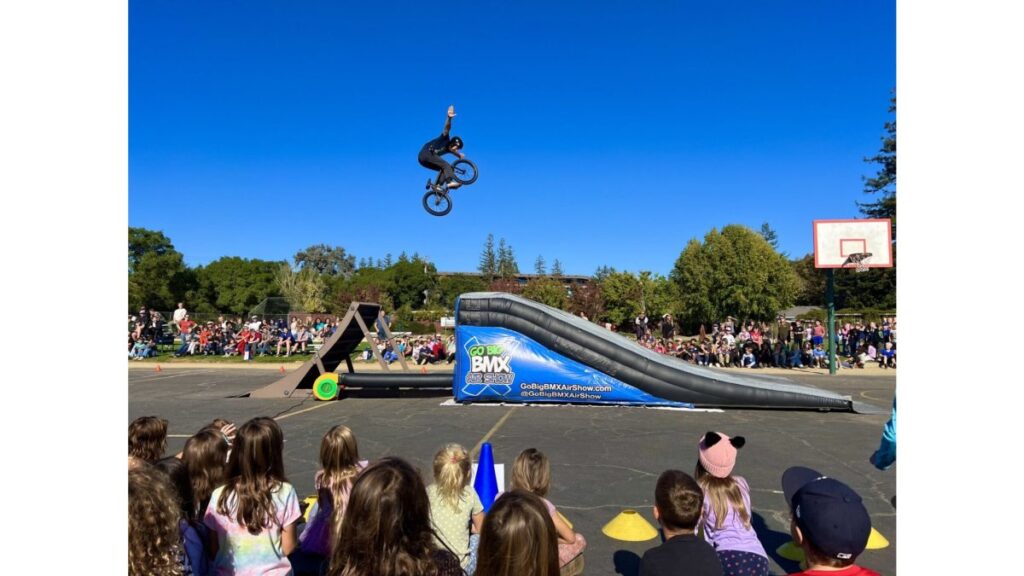
Student engagement during assemblies depends more on pacing than on the program itself. A school assembly works best at 30 to 45 minutes for elementary students and 40 to 50 minutes for middle and high school audiences, with a new stimulus every three to five minutes. GO BIG BMX AIR Show has delivered high-energy assemblies for over 29 years and more than 10,000 shows.
Attention does not fade gradually. It drops in steps, usually after a long speech, a slow transition, or a silent pause. The fix is rhythm:
- Open with a high-energy hook in the first 60 seconds
- Alternate talking segments with movement or demonstration
- Cap any single speaker at five minutes
- Place the emotional peak at the two-thirds mark
- Close with one clear call to action, not three
The National Association of Elementary School Principals guidance on school climate reinforces that shared experiences shape school culture. A tight run time protects that experience.
For a deeper look at pacing with younger adolescents, this guide on planning engaging school assemblies for middle schoolers breaks down timing by grade band.
Interactive School Assembly Ideas That Pull Students In
Interactive school assembly ideas work when students do something, not just watch. Hands raised, voices in the room, and volunteers on their feet all raise participation. A learner-centered approach turns an audience into a group of participants.
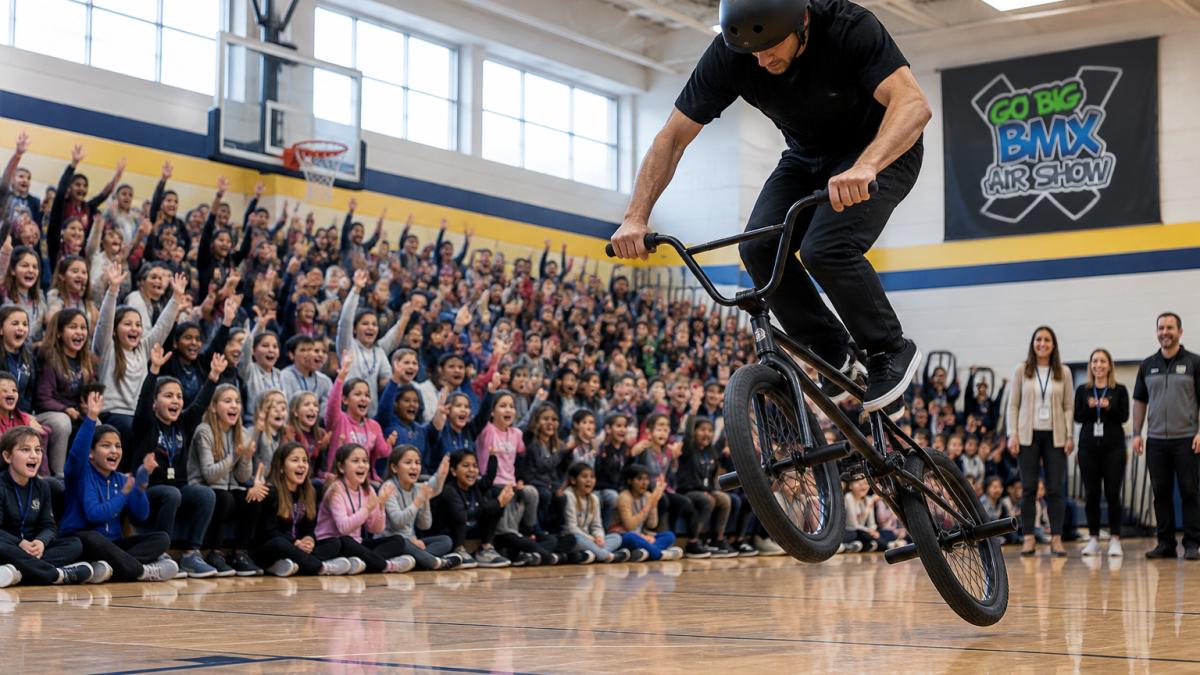
The energy of a live stunt shows how participation can turn an audience into active learners, and the same principle applies to engaging students in class.
Try these formats:
- Live polls with a show of hands, tallied on stage
- Student volunteers for safe demonstrations
- Call-and-response chants tied to the message
- Peer shout-outs for students who model respect
- Question-and-answer segments with the presenter
Age matters here. Younger students respond to simple call-and-response, while older students need student voice and real stakes. For age-specific examples, see these elementary school assembly ideas, and for message-driven formats, this collection of character development assembly ideas pairs well with any engagement plan.
Student Engagement Strategies for Schools: A Practical Run-of-Show
Effective student engagement strategies for schools often follow a timed run-of-show. A written schedule keeps transitions fast and prevents dead air.
| Time | Segment | Purpose |
|---|---|---|
| 0-2 min | Music and entrance | Sets energy, signals start |
| 2-5 min | Welcome and hook | Grabs attention immediately |
| 5-15 min | Main demonstration | Delivers the wow moment |
| 15-25 min | Message and student participation | Connects action to lesson |
| 25-35 min | Second demonstration and Q&A | Rebuilds energy |
| 35-40 min | Close and call to action | Lands one takeaway |
Watch out: the most common mistake is stacking announcements before the hook. Students check out in the first two minutes, and the presenter never gets them back. Build the run-of-show around transitions, and rehearse them.
Accessibility matters too. Reserve front-row seating for students with mobility needs, use a microphone for every speaker, and consider a quiet alternative space for students who find large crowds hard.
Your School Assembly Planning Checklist
A school assembly planning checklist turns good intentions into a smooth event. Work through it in order, and assign one staff member to own each section.
- Define a clear purpose and one learning goal
- Confirm the date, venue, and bell schedule
- Check technology: sound, microphone, and backup power
- Share the run-of-show with every teacher in advance
- Plan student seating by grade and accessibility needs
- Brief volunteers on their roles and cues
- Prepare a backup activity if a segment runs short
- Send a follow-up lesson or discussion prompt to teachers
When the checklist is done, the next step is choosing the program. A BMX School Assembly like the GO BIG BMX Assembly brings professional riders and a character message into one 40-minute show, and the booking form reserves a date without a long back-and-forth.
Frequently Asked Questions
How long should a school assembly last to keep students’ attention?
Most K-12 assemblies work best in the 30 to 45 minute range. Younger elementary students focus for roughly 20 to 30 minutes, while middle and high schoolers can handle 40 to 45 minutes if the format changes every few minutes. Build in a strong hook in the first two minutes, vary the delivery with demonstrations, questions, and movement, and end on a clear takeaway. Anything past 50 minutes without a format shift tends to lose the back rows first.
What interactive school assembly ideas work for large audiences?
Large groups respond to anything that gives them a visible role. Try live polls with hand raises, call-and-response chants, student volunteers pulled from the crowd, and quick team challenges between grade levels. Low-tech options like a thumbs-up check, a stand-if-you-agree prompt, or a repeat-after-me moment cost nothing and lift participation fast. The key is spacing these moments every five to seven minutes so energy stays high from start to finish.
How can presenters keep elementary, middle, and high school students engaged during an assembly?
Adjust tone and content to each developmental stage. Elementary students respond to storytelling, big visuals, and simple call-and-response. Middle schoolers want relevance and a bit of edge, so connect the message to real social situations they recognize. High schoolers tune out anything that feels preachy, so lead with authenticity and let them ask questions. Across all ages, a dynamic presenter who varies energy, moves around the space, and invites student voice will hold attention far better than a scripted lecture.
Keeping students engaged during assemblies is not about finding a louder presenter. It is about pacing, participation, and a plan that respects students’ time. GO BIG BMX AIR Show combines live pro BMX demonstrations with anti-bullying and motivation messaging, backed by 29 years of experience and more than 10,000 shows nationwide. Get started with GO BIG BMX AIR Show and bring an assembly students remember past the final bell.
