
Last Updated: November 26, 2026
Quick Summary
Teamwork activities for school assemblies are short, low-equipment games that get students cooperating on a shared task in front of their peers. Three strong options are a group ball pass, a human knot, and a silent line-up, each run in under eight minutes.
- The group ball pass takes five to seven minutes and needs one soft ball per group of eight to ten students.
- The human knot works best with groups capped at eight so the puzzle stays solvable.
- The silent line-up needs no equipment and is the lowest-risk warm-up before the ball pass.
- Close each activity with one debrief question, such as what helped the group communicate.
Table of Contents
- Why Teamwork Activities Belong in School Assemblies
- Team-Building Activities for Students That Fit a 30-Minute Assembly
- Building a Teamwork Assembly Script Around One Shared Goal
- School Assembly Activity Ideas for Teachers and Performance Ideas That Keep Students Engaged
- Frequently Asked Questions
Why Teamwork Activities Belong in School Assemblies
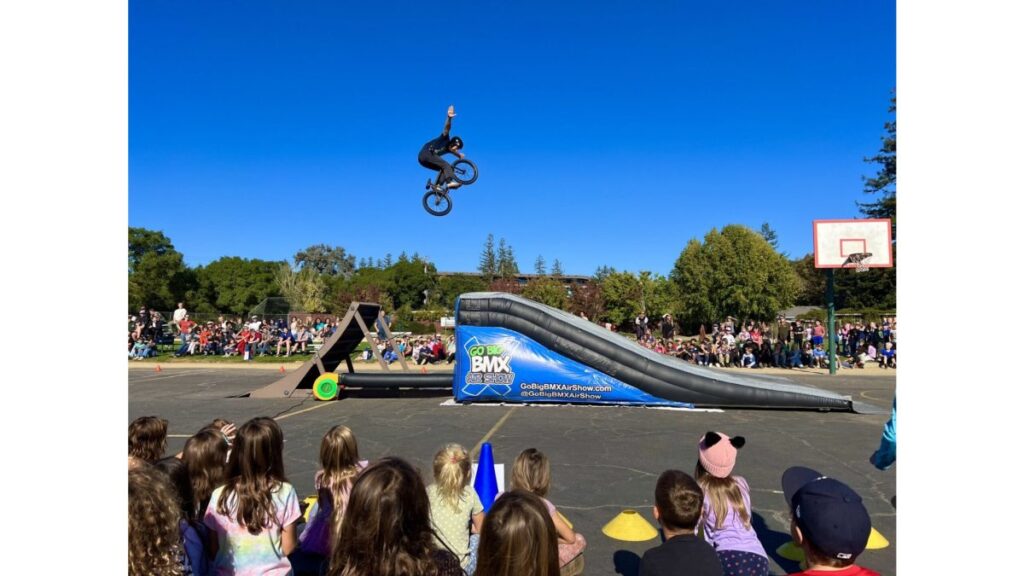
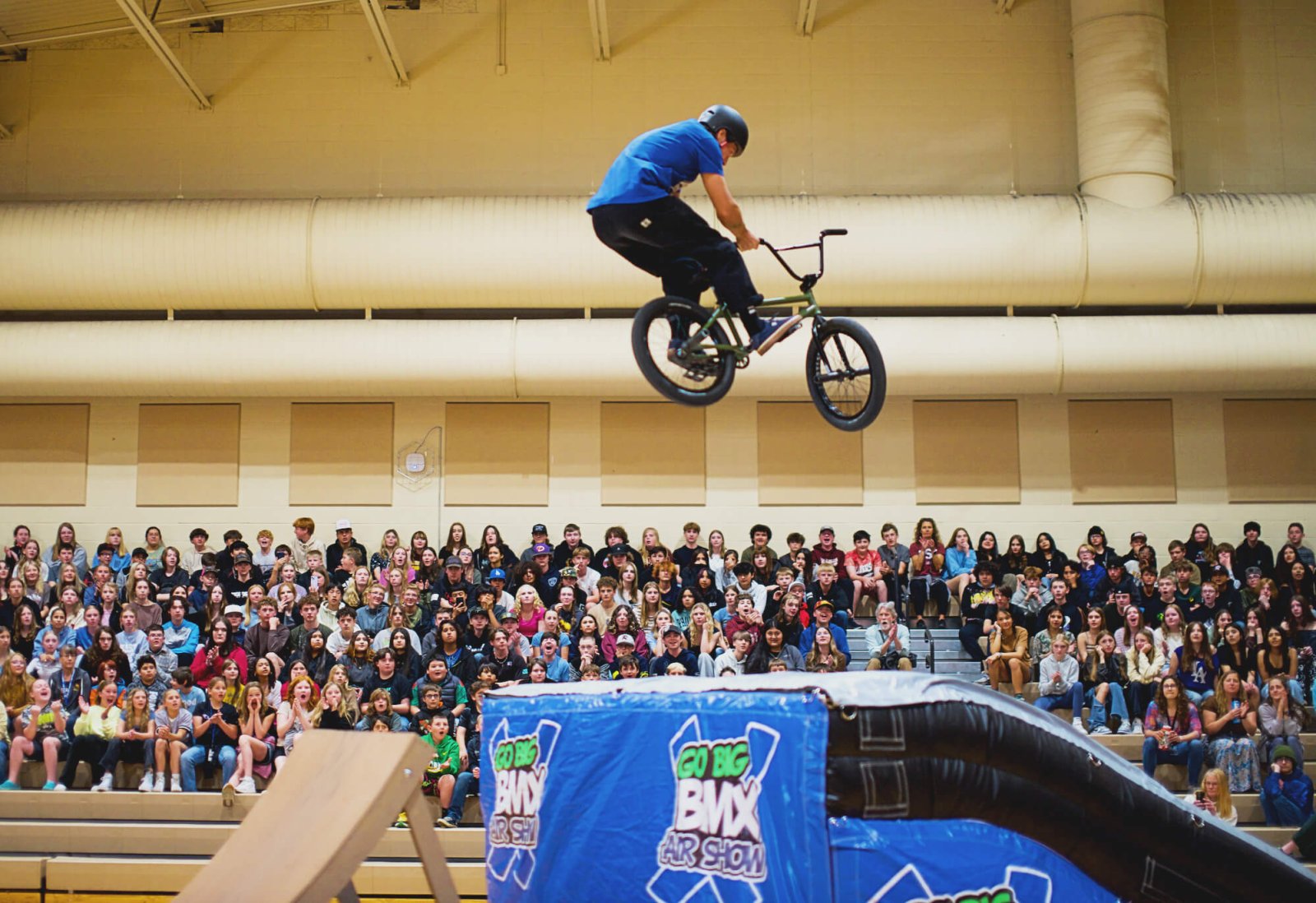
Teamwork is one of the most practical lessons a school can teach, and assemblies let you teach it to the whole student body at once. When students cooperate on a shared task in front of their peers, they practice communication, listening and shared responsibility in a setting that feels memorable rather than instructional. GO BIG BMX AIR Show pairs live athletic performance with messages about respect and personal motivation.
Team-Building Activities for Students That Fit a 30-Minute Assembly
Short, focused activities keep attention high and leave room for the main program. The three below need little or no equipment, scale from a single class to a full gym, and run in under eight minutes each.
1. Group Ball Pass (5-7 minutes). Materials: one soft ball or beach ball per group of eight to ten students. Setup: students stand in a circle, shoulder to shoulder, and pass the ball around without letting it touch the floor, then repeat faster on a second round.
2. Human Knot (6-8 minutes). Materials: none. Setup: groups of six to eight students stand in a tight circle, reach across, and each takes the hand of two different people, then untangle without letting go. Cap groups at eight so the puzzle stays solvable. Facilitator prompt: “Who is leading, and who is being heard?” One or two voices often dominate until an adult or peer explicitly invites quieter members in, name that aloud afterward.
3. Silent Line-Up (4-5 minutes). Materials: none. Setup: students arrange themselves in order by birthday month, height, or first letter of their first name without speaking. This is the lowest-risk entry point and works well as a warm-up before the ball pass. Facilitator prompt: “What did you use instead of your voice?”
Age and group-size adaptations. For younger pupils, replace the human knot with a partner mirroring game and keep the ball pass to one round. For older pupils, add a rule to the ball pass (for example, no passing to the person beside them) to force wider communication.
Accessibility and inclusive participation. Offer seated versions of the ball pass and silent line-up for students with mobility needs. For sensory or communication needs, allow written or gestured contributions in the silent line-up and pair students who prefer not to hold hands in the human knot with a shoulder-tap alternative. Always provide a noncompetitive role, such as timekeeper or observer, so every student can contribute without being put on the spot.
Debrief questions. Close each activity with one question, not three: “What helped your group communicate?”, “Who made sure everyone was included?”, or “What would you change next time?” Tie the answer back to a classroom situation students recognize, such as group work or the lunch line.
Measuring outcomes. Watch for turn-taking, listening (students repeating a peer’s idea), shared decision-making, and whether quieter members are invited in. A simple tally of these four indicators across the assembly lets staff record what they observe during the activity. Tracking these behaviors can also help staff shape science activities around shared discovery, where Dinosaurs Rock becomes a prompt for students to listen, decide, and build on one another’s ideas.
Setup time for three teamwork activities
Building a Teamwork Assembly Script Around One Shared Goal
A strong teamwork assembly script centers on one shared goal every student can help reach. The framework below runs about 25 minutes and fits around a featured performance.
Minute 0-3: Name the goal. Open with a single sentence the whole room can repeat, such as “Today we are going to show that this school works best when everyone contributes.” Write it on a slide and leave it up for the whole assembly. One goal, stated once, beats a list of values.
Minute 3-8: Model the behavior. Run one short activity (the silent line-up works well here) with volunteers on the floor. Narrate what you see: “Notice how they are using hand signals instead of voices.” Naming the behavior in real time turns a game into a lesson.
Minute 8-15: Build toward the goal. Have the audience complete a series of small tasks that build toward the stated goal, a seated ball pass in rows, a call-and-response, or a quick show of hands for each contribution. Each segment should take under three minutes and end with one reflection question.
Minute 15-22: Anchor with the performance. A live sports performance gives students a visual model of the same message: a rider succeeds only when the crew, the spotter, and the audience all play their part. Explore the program options on the BMX school assembly page to see how a live performance can anchor that message.
Minute 22-25: Close the loop. Return to the goal sentence and ask students how their individual contributions helped the group. End with one commitment the whole school can keep, such as “this week, I will invite one person into my group.”
Facilitator prompts to keep in your pocket. “Who has not spoken yet?”, “What did your group agree on first?”, and “What would you tell next year’s class about this?” Each one redirects attention from winning to working together.
Watch out: scripts that stack too many activities in a row lose the room by minute ten, keep one activity, one reflection, and one performance anchor per assembly.
Transfer to classrooms. Send teachers a one-page follow-up with the goal sentence and two debrief questions so the assembly connects to group work, friendships, and everyday school situations. For a detailed walkthrough of booking steps, see 7 Steps to Book a BMX School Assembly.
Schools looking for more elementary-level ideas can start with school assembly ideas for elementary school students, and those comparing anti-bullying formats may find 5 anti-bullying activities for elementary students that work useful.
School Assembly Activity Ideas for Teachers and Performance Ideas That Keep Students Engaged
Teachers planning school assembly activity ideas often combine interactive segments with a featured performance. Student-led presentations, short video segments and quick group challenges keep energy high. Live sports performances add a visual anchor to the assembly’s message.
For a detailed walkthrough of booking steps, see 7 Steps to Book a BMX School Assembly.
Schools looking for more elementary-level ideas can start with school assembly ideas for elementary school students, and those comparing anti-bullying formats may find 5 anti-bullying activities for elementary students that work useful.
Frequently Asked Questions
What are some fun and engaging activities for a school assembly?
The most engaging school assembly activities give students a role to play. Options include a human knot where small groups untangle themselves without letting go of hands, a relay where each team member must complete one part of a task, and a live demonstration with student volunteers working toward a shared result. Keep each activity to three to five minutes, name the teamwork skill it builds, and close with one debrief question so students connect the activity to their own school community.
How do you keep students engaged during a school assembly?
Students stay engaged when the assembly moves between speaking, participation and performance every few minutes. Invite volunteers from different grades, use short turn-taking games, and give a clear signal when it is time to listen. Live sports demonstrations, such as a BMX stunt show paired with an anti-bullying message, combine visual excitement with a clear lesson. Plan for a short question round at the end so students reflect on what they saw.
Can you give me some examples of teamwork in school?
Teamwork in school includes group science projects, peer tutoring, cooperative sports, and student-led clubs that plan a shared event. In an assembly setting, teamwork appears when students pass an object without dropping it, complete a building challenge with a partner, or cheer for a classmate’s success. Pointing out these moments during the assembly helps students recognize teamwork they already practice in class.
