
Last Updated: November 12, 2026
Quick Summary
Interactive school assemblies that students love replace passive listening with participation, so students volunteer, cheer, and answer questions instead of just watching. The strongest formats include action sports demonstrations with volunteer participation, STEM challenge shows, and team-building game shows. Match the format to your learning goal, grade band, and audience size before booking.
- Action sports demonstrations with volunteer participation suit grades 4-12 and audiences of 200-800 in a gym.
- STEM and STEAM challenge shows work best for grades 3-8 and align with NGSS-style engineering practices.
- Reading motivation rallies are most effective when the provider leaves a reading log or challenge chart for two to four weeks.
- Confirm the provider offers opt-in or team-based participation so competition formats don’t single out students.
- Repeat a one-question teacher baseline within a week after the assembly and compare results by grade band.
Table of Contents
- Why Interactive School Assemblies That Students Love Outperform Traditional Formats
- 7 Interactive Assembly Ideas That Captivate Students
- Engaging School Assemblies for Middle Schoolers: What Works at This Age
- How to Plan a Successful School Assembly: A Checklist for Coordinators
- Frequently Asked Questions
Why Interactive School Assemblies That Students Love Outperform Traditional Formats
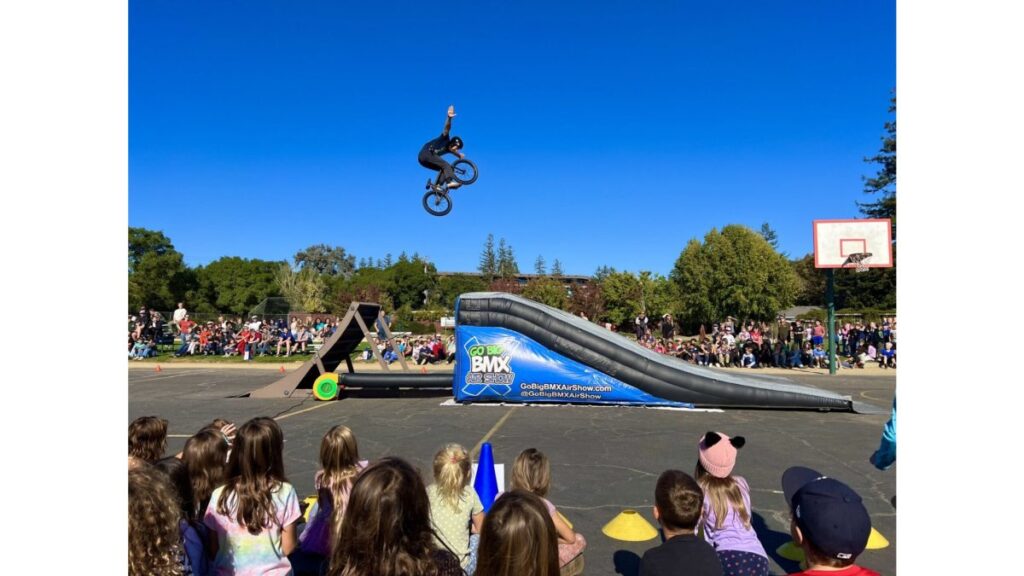
Interactive school assemblies that students love replace passive listening with participation, and that shift changes how much students remember. GO BIG BMX AIR Show has performed over 10,000 shows across 29 years on that principle: athletes perform, students respond, and the message lands while attention is high. The best assemblies are not a break from learning, they are the learning.
Edutopia’s research on student engagement consistently points to active participation as a driver of retention. When students volunteer, cheer, and answer questions on the gym floor, they stay with the program from start to finish.
7 Interactive Assembly Ideas That Captivate Students
The strongest formats share one trait: students do something, not just watch something. The seven formats below are ranked by how much active student participation they generate, with the practical criteria that matter when comparing providers: learning goal fit, age range, audience size, accessibility, and setup time.
- Action sports demonstrations with volunteer participation. A performer with genuine skill earns attention first; the character message lands second, while students are still locked in. Best for grades 4-12 and audiences of 200-800 in a gym. A BMX School Assembly is an example of this format, pairing professional riders with a character-education message.
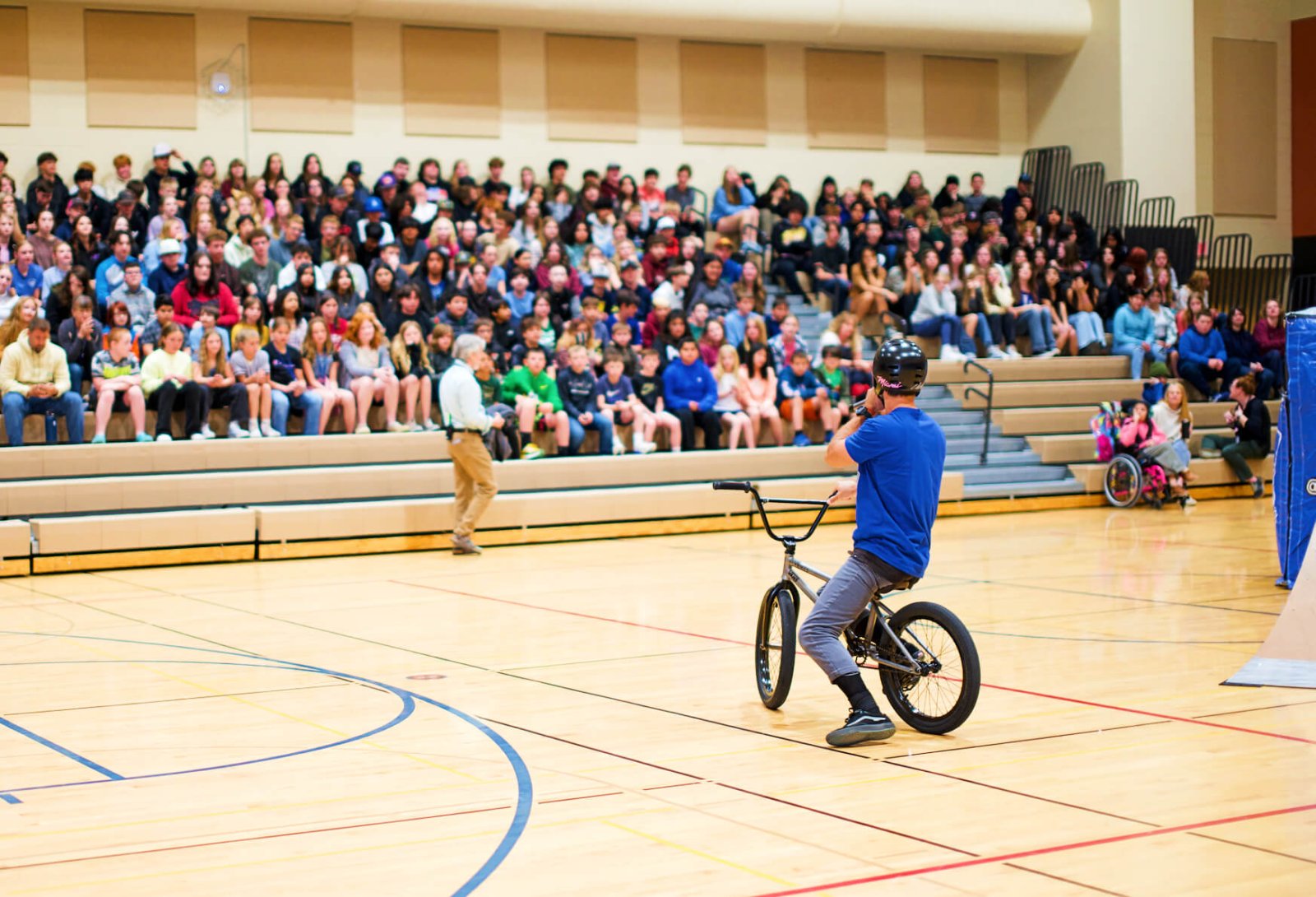
A cyclist in a blue shirt and helmet performs a BMX trick on an indoor court while a large crowd of students watches from bleachers. - STEM and STEAM challenge shows. Students solve a visible problem on stage, build, test, revise, while the audience predicts outcomes. Strong curriculum alignment with NGSS-style engineering practices. Works best for grades 3-8; confirm whether the provider supplies all materials and cleanup.
- Anti-bullying and kindness programs built around student pledges and role-play. Pair with your existing SEL scope and sequence so the assembly reinforces, not replaces, classroom lessons.
- Reading motivation rallies with storytelling, music, and student book challenges. Most effective when the provider leaves behind a simple reading log or challenge chart teachers can run for two to four weeks. Ask what follow-up materials are included.
- Cultural awareness performances featuring student volunteers and live music. Depth depends on preparation: the best programs send pre-visit reading or discussion prompts so students arrive with context rather than watching passively.
- Team-building game shows with grade-level contests and audience involvement. High energy, low prep, and easy to scale to large audiences. Watch out: competition formats can single out students who dislike the spotlight, so confirm the provider offers opt-in or team-based participation rather than individual call-ups.
- SEL-focused multimedia presentations combining video, storytelling, and discussion. The most flexible format for hybrid or budget-constrained schools because it can run live or streamed. Confirm whether the discussion portion is led by a facilitator or handed to teachers.
A practical selection framework: before requesting quotes, write down your learning goal, target grade band, expected audience size, available floor or stage space, and the follow-up time teachers can realistically give. Programs like the assemblies offered by GO BIG BMX AIR Show combine live performance and educational messaging. Coordinators who want more format options can review engaging school assemblies for middle schoolers for age-specific ideas.
Here is a quick comparison of the seven formats, ranked by how much active student participation they generate.
| Format | Best for | Key detail |
|---|---|---|
| Action sports demonstrations with volunteer participation | Grades 4-12, audiences of 200-800 in a gym | Performer skill earns attention first, message lands second |
| STEM and STEAM challenge shows | Grades 3-8 | Strong alignment with NGSS-style engineering practices |
| Anti-bullying and kindness programs | Pair with existing SEL scope and sequence | Built around student pledges and role-play |
| Reading motivation rallies | Provider leaves a reading log or challenge chart | Follow-up runs two to four weeks |
| Cultural awareness performances | Best with pre-visit reading or discussion prompts | Features student volunteers and live music |
| Team-building game shows | High energy, low prep, scales to large audiences | Confirm opt-in or team-based participation |
| SEL-focused multimedia presentations | Hybrid or budget-constrained schools | Can run live or streamed |
Engaging School Assemblies for Middle Schoolers: What Works at This Age
Middle schoolers disengage fastest when a program feels childish or preachy. The fix is honesty and physical energy: action-based formats let students see real skill, then hear a real message from the performer.
SEL and character-building themes land better through story than lecture. The impact of SEL in school assemblies grows when students participate directly instead of listening passively.
How to Plan a Successful School Assembly: A Checklist for Coordinators
A successful assembly comes down to preparation on both ends, before the event and after it. Use this checklist before booking:
- Confirm the date, start time, and total audience size, and decide whether you will run one large session or two smaller ones by grade band
- Verify gym or auditorium space, ceiling clearance, floor surface, and access routes for equipment
- Check insurance and safety documentation from the provider, and confirm who supervises students during volunteer segments
- Align the program’s message with your current SEL or anti-bullying focus and share your scope and sequence with the provider
- Plan for accessibility and inclusive student participation, sensory needs, mobility access, language differences, and students who prefer not to be singled out
- Schedule a brief staff briefing before the event so teachers know their supervision zones and the follow-up plan
- Build a contingency plan for equipment failure, weather (for outdoor setups), and schedule overruns
- Send the follow-up discussion guide to teachers afterward
Measuring impact after the assembly. The gap most programs leave open is evidence. These reflective practices often reveal a need for more hands-on reinforcement, which can be addressed by integrating low budget STEM activities into the curriculum to solidify the concepts introduced during the assembly.
Logistics and safety planning. Confirm supervision ratios with your administration, designate a staff member as the provider’s on-site contact, and walk the space with the performer before students arrive.
Budgeting and funding. Ask providers about per-student rates, travel fees, group-size limits, and piggyback dates that let neighboring schools share a single visit. For the booking process itself, see how to book school assembly performances, and contact the GO BIG BMX AIR Show team with scheduling questions.
Schools face a real challenge: finding an assembly that holds attention and delivers a message students carry back to class.
Frequently Asked Questions
What makes interactive school assemblies truly engaging for students?
Interactive school assemblies work because they pull students into the action instead of talking at them. Student volunteers, live demonstrations, games, and audience involvement keep attention high. Programs that combine entertainment with a clear message, like action sports shows that weave in anti-bullying and character lessons, hold attention longer than a speaker behind a podium. The mix of excitement and meaning is what students remember.
How can principals measure the success of an assembly program?
Principals can gauge impact through brief student and staff surveys, tracking office referrals in the weeks after the show, and observing whether students reference the message in class. Asking teachers for informal feedback on student engagement during and after the assembly also helps. Programs built around social-emotional learning themes give schools a clear framework to check whether the message carried past the event.
How much advance notice does a school need to book an assembly?
Booking timelines vary by provider and season, so it is best to reach out early and ask about available dates. Many schools book months ahead for popular programs, especially in spring. If your calendar is already full, ask whether the provider can work around your existing schedule. Requesting a dates and rates list is the fastest way to see what fits your campus.
