
Last Updated: November 19, 2026
Quick Summary
Engaging student assemblies for non-sports kids match the format to student interests rather than tradition, using arts showcases, STEM challenges, game show formats, and creative club events. Survey students privately first, then rotate one format from each preference cluster across the year so no single group owns the spotlight. Build in sensory and accessibility accommodations, including quiet spaces and opt-out language, so every student can participate comfortably.
- Survey students privately in advisory or homeroom with five questions and no names required.
- Rotate one format from each preference cluster across the year so no group owns the spotlight.
- A film festival needs a screen, sound, and a submission deadline two weeks out.
- Publish a one-page preview describing what will happen, how loud it will get, and expected participation.
- Run a three-question anonymous post-assembly survey in advisory the next day to check inclusion.
Table of Contents
- Why Non-Sports Students Get Left Out of Assembly Planning
- School Assembly Activities Ideas That Reach Every Student
- Interactive School Assemblies That Pull Students In
- School Assembly Ideas for Middle School Students Who Tune Out
- School Assembly Activities Ideas for Teachers to Extend the Learning
- Designing Inclusive Assemblies for Sensory and Accessibility Needs
- Frequently Asked Questions
Why Non-Sports Students Get Left Out of Assembly Planning
Most school assembly calendars assume students will get excited about athletic competition. Pep rallies, sports awards nights, and team send-offs dominate the schedule, and students who don’t play quietly disappear into the bleachers.
The hidden cost isn’t visible on a permission slip. It shows up in the student who stops volunteering, the one in the back row with a hood up, the one who says assemblies “aren’t for people like me.”
The Hidden Cost of Pep Rally Culture
Pep rallies reward a narrow slice of the student body. When the same students get the spotlight every fall, everyone else learns that their talents don’t count here.
The fix isn’t to cancel spirit events. It’s to widen what gets celebrated. A structured approach to keeping students engaged during assemblies makes that rotation realistic.
School Assembly Activities Ideas That Reach Every Student
The strongest assembly programming matches format to interest rather than format to tradition. A school assembly is a shared gathering with a performance or presentation component, built to create community, deliver a message, or showcase student work.
Arts, Music, and Cultural Performances
School band, choir, theater, dance, and cultural groups already exist on most campuses. They just rarely headline. Giving them a full assembly slot, such as a winter showcase or a spring theater preview, lets them headline. The audience is broader than a sports crowd because the performers are a broader cross-section of the school.
STEM Challenges and Science Demonstrations
Science demonstrations and hands-on STEM challenges turn spectators into participants. A science fair preview, a live demo from the science club, or a class-versus-class engineering challenge gives analytical students a stage, rewarding curiosity instead of speed or strength.
Interactive School Assemblies That Pull Students In
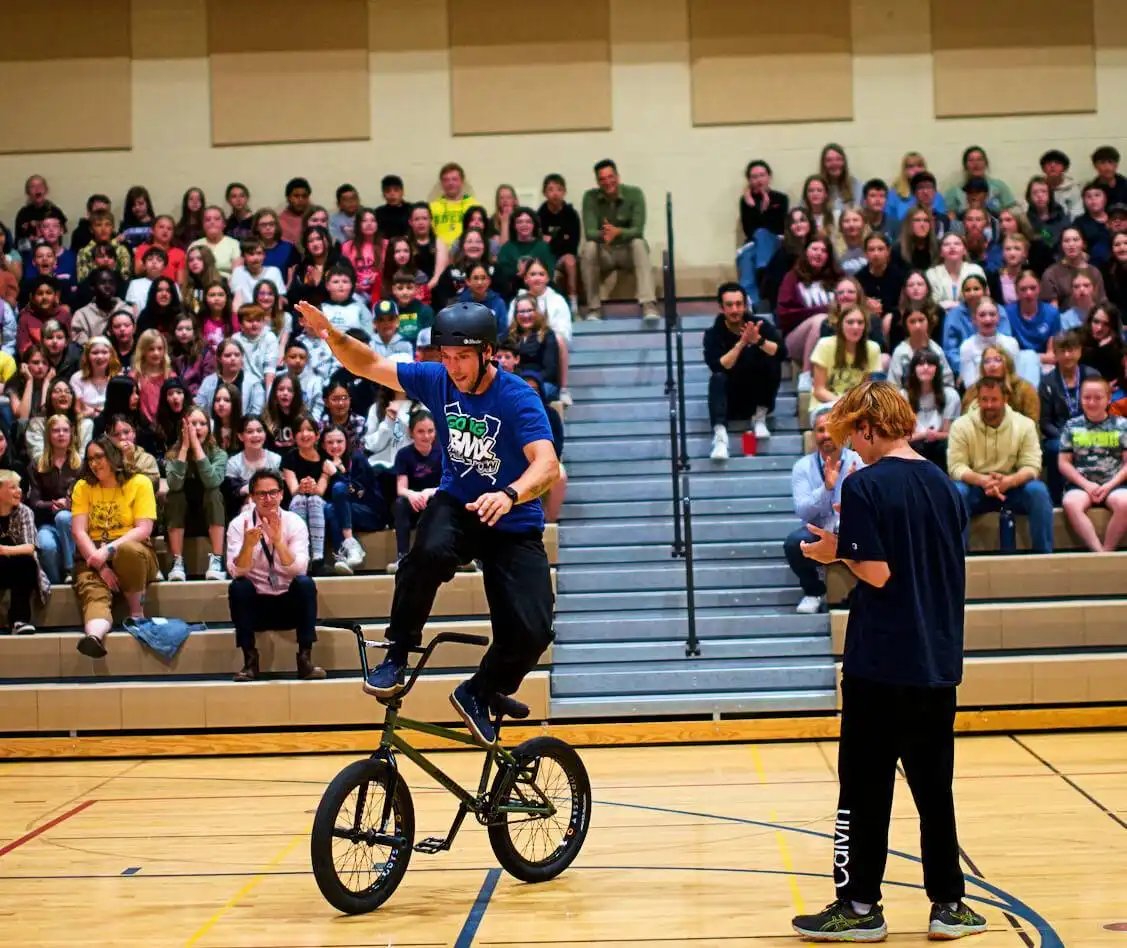
Interactive formats work because participation is voluntary and low-stakes, letting students opt in without risking embarrassment.
Team-Building Games and Game Show Formats
Game show formats and team-building challenges spread participation across grade levels and friend groups. Mixed-grade teams, random draw brackets, and quick rounds keep energy high and pressure low. Students who would never try out for a team will happily join a trivia bracket or relay challenge when the stakes are a ribbon and bragging rights.
For more formats that actively involve the crowd, these interactive school assemblies offer a useful menu to draw from.
School Assembly Ideas for Middle School Students Who Tune Out
Middle schoolers disengage fast and announce it loudly. The fix is relevance: formats that touch gaming, debate, creative clubs, and student-led content hit the interests this age group actually claims as their own. A gaming tournament, a debate showcase, or a yearbook and literary magazine launch gives students ownership rather than a seat.
Match the Format to the Student, Not the Calendar
The most reliable way to reach students who tune out is to stop planning by tradition and start planning by preference.
| Student Preference Cluster | What They Tend to Avoid | Assembly Formats That Fit | Typical Duration | Group Size |
|---|---|---|---|---|
| Creative and performance-oriented | Being put on the spot without preparation | Talent showcase, theater preview, art exhibition walk-through, literary magazine launch | 30-45 minutes | Whole grade level |
| Curious and analytical | Loud, chaotic crowds; speed-based competition | Science demo, design challenge, trivia bracket, robotics or coding showcase | 40-50 minutes | 100-200 students |
| Social and competitive | Passive sitting; long speeches | Game show format, class-versus-class challenge, debate showcase | 45-60 minutes | Whole school or grade band |
| Quiet and observant | Forced participation; surprise volunteers | Film festival, student-produced video showcase, guest speaker with Q&A, gallery walk | 30-40 minutes | 75-150 students |
Typical Duration
A common pattern is to rotate one format from each cluster across the year so no single group owns the spotlight. That rotation also spreads setup and staffing demands instead of loading every assembly onto the same activities department.
Interest-Based Formats: Gaming, Debate, and Creative Clubs
Interest-based assembly planning means surveying students first, then building the calendar around what they name.
Gaming deserves a specific note because it is the interest middle schools most often overlook.
Watch out: interest surveys that ask students to name a favorite activity in front of peers produce skewed answers. Collect responses privately so quiet students report honestly.
Implementation Details That Make or Break the Format
Setup and staffing vary more than the idea list suggests. A trivia bracket needs a projector, a buzzer or buzzer app, and two staff members to run scoring. A design challenge needs tables, materials, and a judge panel.
Middle school programming needs its own playbook, and these assembly ideas for middle schoolers go deeper on age-specific formats.
School Assembly Activities Ideas for Teachers to Extend the Learning
An assembly that ends when the bell rings wastes its momentum. Teachers can extend the learning with a short reflection prompt, a follow-up discussion, or a classroom activity tied to the assembly theme. A character education assembly on kindness becomes a week of service projects.
The most effective extension is simple: ask students what they’d want to see next and build the next assembly from their answers. To see how a full program can anchor that loop, browse our assemblies for formats that pair entertainment with a message students carry back to class.
| Interest Type | Assembly Format | Best For | Teacher Extension |
|---|---|---|---|
| Performance arts | Talent show, band or choir showcase | Elementary through high school | Reflection journal on stagecraft |
| STEM | Science demonstration, design challenge | Upper elementary and middle school | Classroom build challenge |
| Competition | Game show, trivia bracket | Middle and high school | Team standings across the term |
| Creative clubs | Art exhibition, literary magazine launch | Middle and high school | Portfolio or submission drive |
| Service and character | Kindness kickoff, anti-bullying program | All grade levels | Service project week |
Designing Inclusive Assemblies for Sensory and Accessibility Needs
Inclusion is a logistics problem before it’s a values problem. Sensory needs, mobility accommodations, and neurodiversity require planning: seating options, noise levels, lighting, advance notice of loud moments, and quiet spaces for students who need a break. None of it is complicated. All of it gets skipped when nobody asks.
The Practical Accommodations Checklist
Most schools already have the infrastructure; they just don’t route it toward assemblies. The checklist below is the version principals and support staff tend to find most useful because every item can be assigned to a named staff member before the event. Assigning each task to a named staff member also makes it easier to adapt interactive event ideas into assemblies that give students beyond sports a meaningful role.
- Seating: Reserve aisle seats and a back-row section for students who need to exit quickly. Offer a floor-seating option and a chair option rather than assuming one works for everyone.
- Volume: Ask the performer or presenter for a sound check at the actual audience level, not an empty gym. Provide foam earplugs at the door without requiring students to ask.
- Lighting: Confirm whether strobe, flashing, or sudden blackout effects are part of the program. If they are, announce them in advance and offer a seating area outside the effect zone.
Neurodiversity and the Participation Trap
The most common mistake is treating participation as the measure of a good assembly. For neurodivergent students, forced cheering, surprise volunteers, and unpredictable crowd noise turn a shared event into a stress test.
Ask families and support staff early, publish a preview for students who need predictability, and build the schedule with flexibility.
Measuring Whether Inclusion Actually Worked
Inclusion claims are easy to make and hard to verify. A short post-assembly survey, three questions, anonymous, completed in advisory the next day, gives schools real signal. Ask whether students felt they could participate comfortably, whether the noise and lighting were manageable, and whether they would want a similar assembly again.
If your team has questions about accommodations before booking, contact us to discuss what your students need.
Frequently Asked Questions
What are some fun and engaging ideas for a school assembly that don’t focus on sports?
Consider talent shows, STEM challenges, cultural performances, game show formats, or interactive demonstrations. These formats let students shine in areas like music, science, art, and trivia rather than athletics. For example, a school assembly activities ideas list might include a student-led science fair, a poetry slam, or a team trivia competition. The key is offering variety so every student finds something that matches their interests and strengths.
How can schools make assemblies more inclusive for students who do not play sports?
Start by auditing your assembly calendar for sports-heavy themes like pep rallies. Replace or balance them with interest-based options such as arts showcases, STEM demonstrations, and interactive school assemblies that reward participation over athletic ability. Also consider sensory needs by offering quiet seating zones and previewing loud segments. Survey students at the start of the year to learn what they actually want to see, then build a schedule that reflects those preferences.
How long should a school assembly be to keep students engaged?
Most effective assemblies run 30 to 45 minutes for elementary students and 45 to 60 minutes for middle and high school. Within that window, plan for changes every 5 to 10 minutes, such as switching from a demonstration to audience participation or a short video. Interactive school assemblies that build in volunteer moments and quick transitions hold attention far better than a single speaker at a podium for 45 minutes straight.
What activities can students participate in during a school assembly?
Students can volunteer for on-stage challenges, answer trivia questions, join team-building games, or demonstrate skills in talent segments. School assembly ideas for middle school often include game show formats where classrooms compete, hands-on STEM challenges with student volunteers, and Q&A sessions with performers. Teachers can also assign pre-assembly discussion questions so students arrive ready to participate rather than just watch.
